
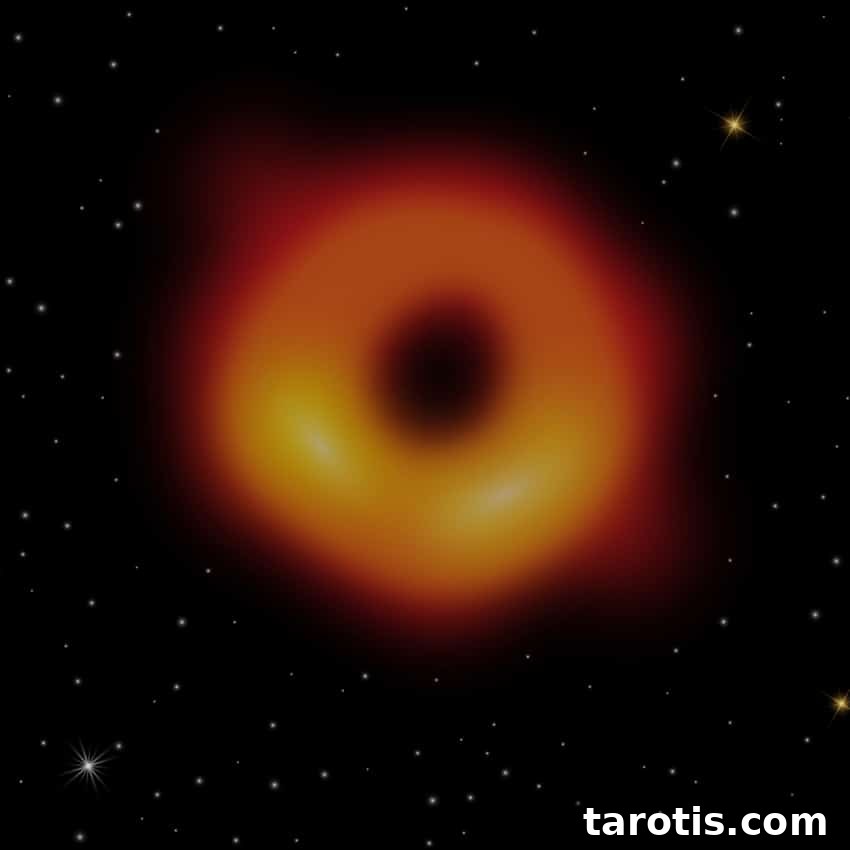
While many of us recognize how planets and stars shape our astrological profiles, other celestial phenomena can also influence our personalities. Meteors, moons and black holes interact with the same constellations and planetary placements that appear in natal charts, yet few people examine how these elements might affect their identity. Read on to learn what a black hole’s presence in your chart might mean.
What Is a Black Hole?
Despite its ominous name, a black hole is not an empty void but an extremely dense concentration of matter compressed into a very small space. Its mass produces a gravitational pull so powerful that nothing, not even light, can escape—hence the term “black hole.”
Einstein’s general theory of relativity describes how black holes form: when a star exhausts its nuclear fuel, its core can collapse under its own gravity. If that remnant core has sufficient mass, gravity overwhelms all other forces and a black hole is born. Smaller stellar remnants may simply fade away, but the most massive collapse into these extraordinary objects.
Black Holes & Astrology
It may sound more like a planetarium lecture than astrology at first, but black holes were once stars and are charted in the sky much like other stellar objects. Astronomers often identify black holes by their position relative to constellations, including zodiac signs. For example, the Milky Way harbors Sagittarius A, a supermassive black hole located near the constellations Sagittarius and Scorpius. In 2019, astronomers captured the first direct image of a supermassive black hole at the center of the galaxy M87, sometimes referred to with constellation-based naming conventions. The positional relationship between black holes and constellations is what makes their astrological placement meaningful.
Should You Care If a Black Hole Appears in Your Chart?
Short answer: yes. Unlike planets, black holes are effectively fixed points; they do not trace orbital paths in the way planets do. They shift only minimally, so other celestial bodies pass near them rather than the black holes moving through the sky. Astrologers propose that a black hole close to a planet in your natal chart can exert a strong influence on that planet’s expression.
In practical terms, a black hole near a planetary placement may intensify that planet’s qualities, amplifying both strengths and shadow aspects. While this intensification can sometimes bring difficult, consuming patterns—such as an exaggerated tendency toward compulsion, obsession, or inner turmoil—it can also heighten magnetism, charisma or focus, depending on the planetary context.
For example, a black hole near the Sun might indicate struggles with identity and a tendency to seek validation from others. A black hole adjacent to Mars could correlate with challenges in managing anger or conflict, while one close to Venus might explain repetitive patterns in romantic attachments or intense emotional entanglements. Conversely, when aligned positively, a black hole near Mercury could amplify persuasive communication and clarity of thought, and one near the Moon might correlate with deep emotional resilience or an unusually strong inner life.
The Light at the End of the Black Hole
Discovering a black hole’s placement in your natal chart is an opportunity for self-observation rather than alarm. Awareness of a stronger pull toward certain shadow patterns allows you to take conscious steps to manage, transform, or integrate those tendencies. Similarly, recognizing amplified positive traits enables you to nurture and use those gifts constructively.
In short, a black hole in your chart signals areas for deeper introspection. It encourages you to reflect on where you might be drawn into extremes and where you might cultivate resilience, self-knowledge and growth.