
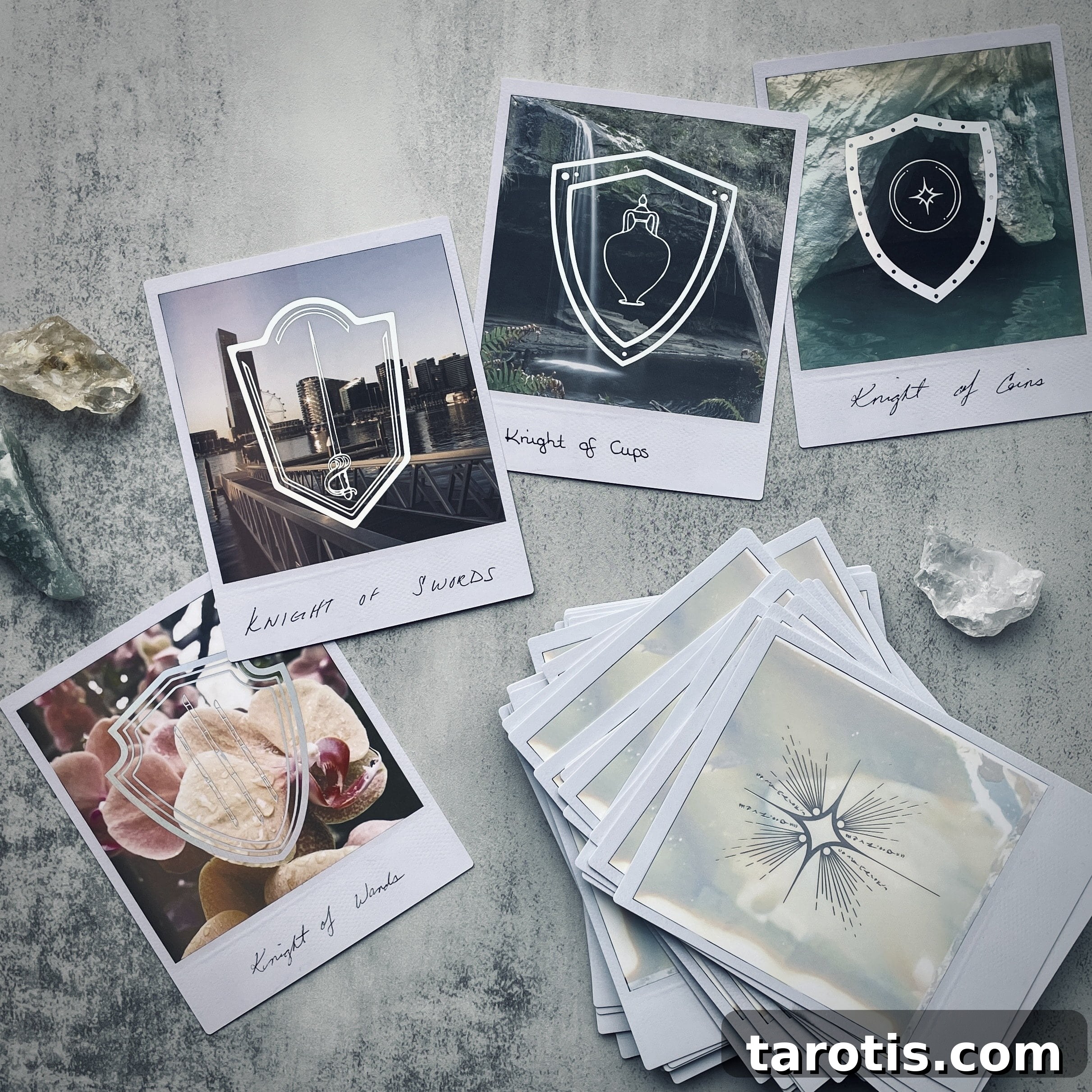
For many readers, the court cards are among the most challenging parts of the Tarot to understand. The Major Arcana draws attention for its sweeping life changes and major decisions, while the minor pips offer practical, everyday guidance and help build clear narrative arcs within each suit.
Yet the court cards—with their faces, elemental correspondences, and human personalities—can feel elusive or confusing. They represent people, styles of being, or approaches to situations that don’t always fit neatly into a reading.
Sixteen cards may seem to cover everything at once: experience, insight, balance, discovery, resources, expansion, creativity, leadership, boundaries, and more. The question is how to work with them effectively and how to channel their qualities for your own growth.
One of the most useful exercises is to work directly with your deck. Pull out the court cards, sit with them, and notice what personal associations they trigger. That direct practice helps you learn how each card’s energy expresses itself in your life.
Below we’ll take a closer look at the Knights.
What Are the Knights in Tarot?
Knights are often labeled as adolescents, explorers, travelers, apprentices, or seekers. They stand between the younger Pages and the more mature Kings and Queens: not brand new to their element, but not yet masters. Knights embody motion, momentum, and the drive to act.
They are adventurous, enthusiastic, and eager to prove themselves. Each Knight has a purpose or goal—sometimes only partially formed—and takes pleasure in the process of pursuing it. This raw, expressive energy favors action and experience over perfection.
Because Knights take risks, their actions can carry higher stakes than those of Pages. That boldness can produce great rewards, but it can also bring stubbornness or tunnel vision. Knights may throw themselves into an idea, ambition, emotion, or dream with single-minded intensity, sometimes overlooking alternative perspectives.
When you combine the Knight’s forward motion with each of the four suits or elements, you begin to see how that drive shows up differently depending on context. Below are brief portraits of each Knight and how their energy typically manifests.
The Knight of Wands
The Knight of Wands is charismatic, bold, and passionate. This Knight inspires others with big ideas and dramatic gestures and is often happiest in the pursuit of new ventures. However, their enthusiasm can lead to distraction; they may be excellent at starting projects but less reliable at finishing them.
The Knight of Swords
The Knight of Swords is quick-minded, analytical, and decisive. They spot connections fast and cut through confusion with logic and speed. Yet when overly focused on a single viewpoint, this Knight can become rigid, dismissing alternative opinions and failing to consider nuance.
The Knight of Cups
The Knight of Cups is romantic, creative, and emotionally open. They seek connection, beauty, and expression, often wearing their heart on their sleeve. That sensitivity is a strength, but when feelings aren’t reciprocated or expectations aren’t met, the Knight of Cups can feel wounded or jealous.
The Knight of Pentacles
The Knight of Pentacles is steady, reliable, and hardworking. Devoted to long-term goals, this Knight advances through persistence and discipline. The downside can be inflexibility: in their commitment to a plan, they may miss possibilities or fail to appreciate the journey itself.
Each Knight contributes boldness, commitment, and a distinctive intensity to their suit. When Knights appear in a spread, they often call you to take a risk, focus on what you’re pursuing, and balance ambition with patience and thoughtfulness.
A practical exercise: pull the four Knights from your deck and place them together. Spend time noticing them as a group and as individuals. Ask yourself what each Knight activates in you—what they invite, challenge, or illuminate. Consider where they might lead you if you allowed their energy to guide your actions. What traits do they share and where do they diverge? If two Knights were in conversation, what would they discuss?
If you’ve been reading Tarot for a while, you might already feel affinity with a particular Knight—one that encourages adventure, one that advises caution, or one that consistently appears when certain themes arise. Compare the four Knights side by side and notice which feel familiar and which feel foreign. Do you see yourself in any of them? Do you recognize friends or acquaintances?
Journaling about each Knight can deepen your understanding. Write what each card means to you, which qualities stand out, and how you might integrate those qualities into your life. Keep the Knights set aside when doing a reading, or place them at the top of your workspace as a reminder to bring courage, focus, and care into your choices.
A Tarot Spread for Tackling Adventure
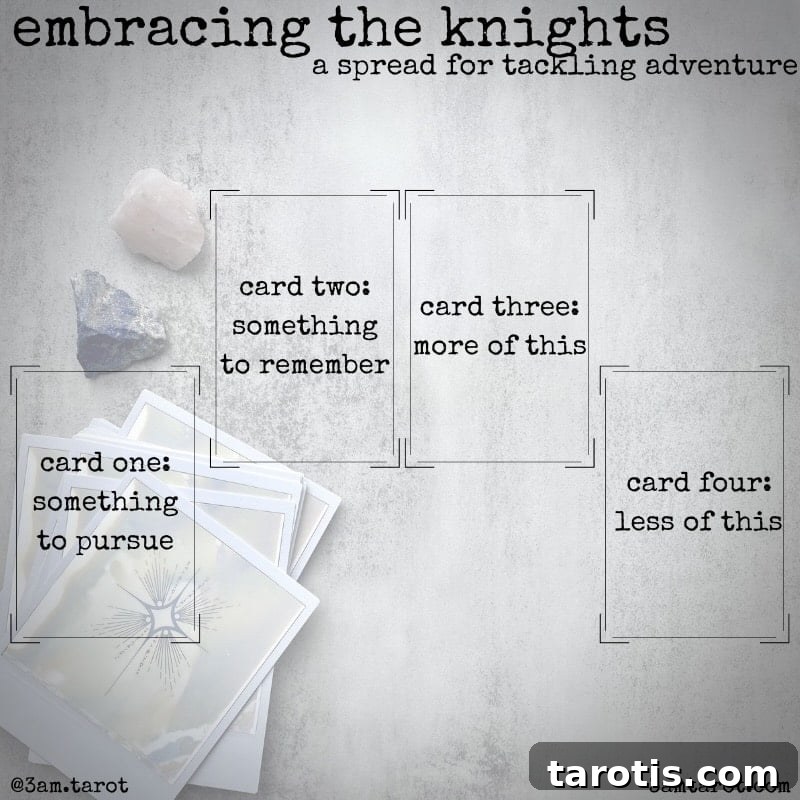
Card One: Something to pursue: What are you ready to explore? What idea or challenge is calling you forward? Where is momentum building, and how will you respond?
Card Two: Something to remember: What lessons from past experiences can you apply now? What insight or inner wisdom is guiding you?
Card Three: More of this: What needs expansion? Where could you bring more inspiration, resources, or collaborative energy?
Card Four: Less of this: What is out of balance or taking over? Where have you been distracted or overcommitted?
Spend time journaling through these prompts with your spread. Where are you invited to grow, change, or try something new? How do you want to prove yourself, and which doors are you ready to walk through? What is manifesting, and how can you be present as that vision takes shape?
Reflect on how the Knights have appeared in your past readings and where they might be guiding you now. Let their energy inform your choices as you move forward.