
Yin and Yang are terms many people have heard, but their deeper meaning is less widely understood. These concepts describe complementary forces that appear opposite yet depend on one another to create balance.
What is the Philosophy of Yin & Yang?
At its core, Yin and Yang expresses the idea that seemingly contradictory forces are interconnected and interdependent. One cannot exist without the other. A simple everyday example is Day (Yang) and Night (Yin). Another is Masculine (Yang) and Feminine (Yin). Although distinct, these polarities coexist and create harmony when balanced.
Consider Day and Night: sunlight and darkness each serve essential roles. Without daylight, life would lack the energy and warmth it needs; without night, there would be no rest or recovery. The balance between them sustains natural rhythms.
Common associations include:
- Yang: white, light, south, fire, active, sky.
- Yin: black, dark, north, water, receptive, earth.
When people try to pair Yin and Yang with moral categories like good and evil, the comparison can be misleading. Yang is often linked with harmony and Yin with passivity or restraint, but labeling one as strictly “good” and the other as “evil” ignores context and subjectivity. Values such as good and bad depend on perspective, needs, and balance. For example, a tourist who only wants sun and a farmer who needs both sun and rain may disagree, but neither is inherently evil. Taoist thought emphasizes that many problems arise from imbalance rather than moral failure.
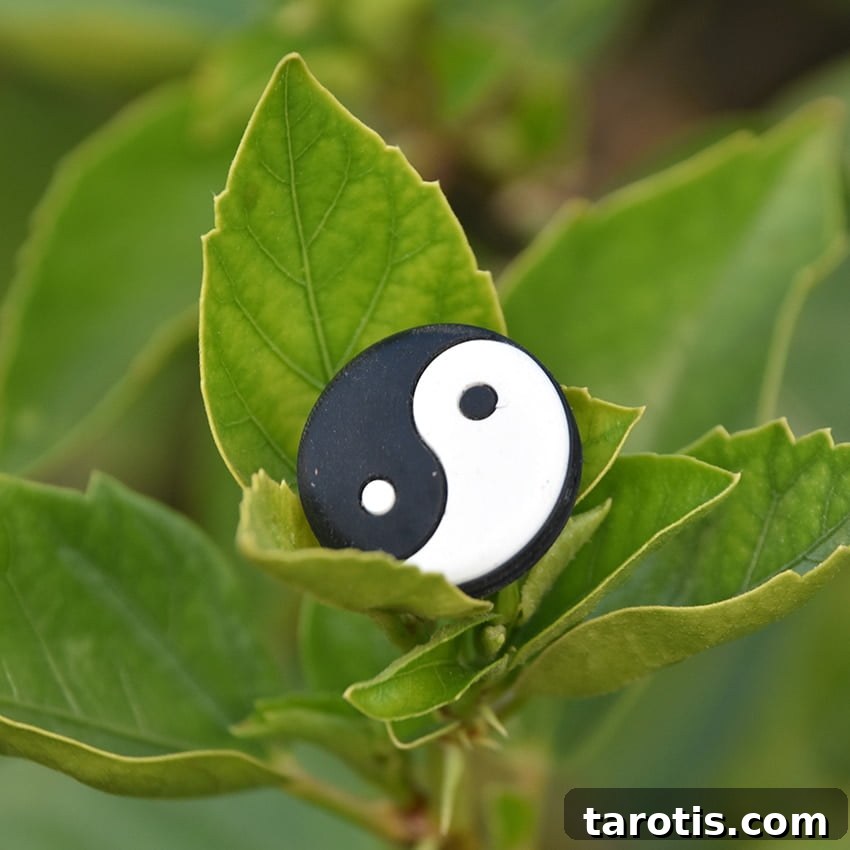
The familiar Yin-Yang symbol—two interlocking teardrop shapes, one light with a dark dot and one dark with a light dot—illustrates this idea: within each side lies a seed of the other. This visual reminds us that equilibrium requires accepting complementary qualities in ourselves and the world. Reconciling inner tensions and fears allows us to act with greater calm and project harmony outward.
Yin and Yang are not absolutes; they are relational. A universe lacking either principle would lose its dynamic order. Carl Jung captured this notion succinctly:
“In all chaos there is a cosmos. In all disorder a secret order.”
Yin & Yang in Chinese Astrology
Yin and Yang form a foundational principle of Taoist thought and influence many aspects of Chinese culture, including traditional medicine, Feng Shui, and Chinese astrology. In the Chinese zodiac, each animal is characterized as Yin or Yang, not to rank them but to balance energies across the cycle—six animals are Yang and six are Yin.
Yang Chinese Zodiac Animals:
- Rat
- Dragon
- Horse
- Monkey
- Dog
- Pig
Yin Chinese Zodiac Animals:
- Ox
- Tiger
- Rabbit
- Snake
- Goat
- Rooster
These classifications reflect general tendencies rather than strict personality rules. The Dragon, for example, is typically associated with Yang qualities: boldness, extroversion, and outward energy. Dragons are often seen as dynamic and ambitious, symbolically reaching for the sky. The Tiger, classified as Yin, tends toward patience and focused purpose—qualities useful for stalking and waiting in the wild. Both signs can display strength and passion, but their internal drives differ: the Dragon’s energy can be fiery and expansive, while the Tiger’s is steady and grounded. Together they illustrate how contrasting energies can complement each other.
Yin & Yang in Western Astrology
Western astrology similarly groups zodiac signs by Yin and Yang qualities, reflecting introverted versus extroverted tendencies.
Yang Zodiac Signs:
- Aries
- Gemini
- Leo
- Libra
- Sagittarius
- Aquarius
Yin Zodiac Signs:
- Taurus
- Cancer
- Virgo
- Scorpio
- Capricorn
- Pisces
Recognizing whether a sign leans Yin or Yang can help explain compatibility and relationship dynamics. Yang signs often appear outgoing and social, thriving in active environments and lively conversation. Yin signs tend to be quieter and more introspective, forming deep emotional connections and preferring closer, more personal interactions. Opposite energies can attract and create powerful partnerships if balanced well, but differences can also create tension if not understood.
Conclusion
Yin and Yang is an ancient framework that continues to offer insight into balance, relationships, and personal growth. As modern life brings new stresses and imbalances, the principle remains relevant: cultivating inner harmony and reconciling opposing tendencies helps individuals and communities achieve stability. By embracing balance in our own lives, we contribute to a more harmonious world.
Related Article: The Masculine & Feminine in Astrology