
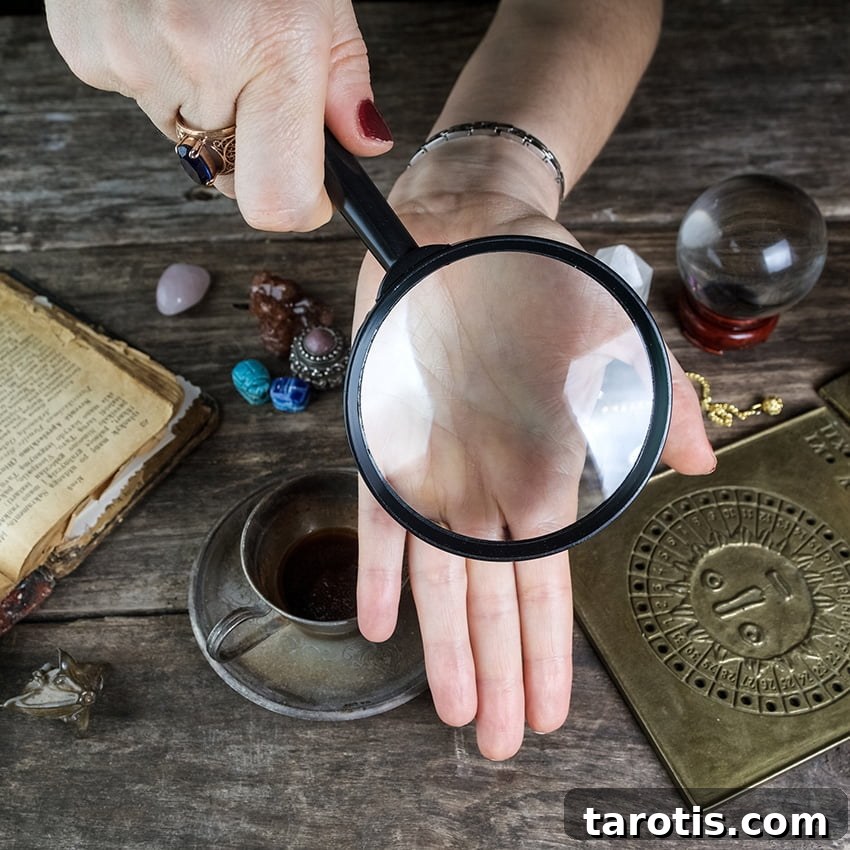
If you’ve been following this palmistry series, you already know the basics of palm reading, what to expect during a session, and the general features of your palm. Now that you understand the main areas of the hand, it’s time to explore one of the most informative elements of chiromancy: the mounts of the hand.
In palmistry, “mounts” are the fleshy pads scattered across the palm. Because these pads vary in size and shape, they provide important clues about personality, temperament, and potential. Below, we’ll explain how to find each mount and what common interpretations of their features can reveal.
Identifying the Mounts on Your Palm
Clear observation is essential in palmistry. To locate the mounts, use two simple hand positions:
First, hold your palm up with fingers flattened, as if balancing a tray. This position highlights the finger mounts (at the base of each finger) and the Plane of Mars in the center of the palm.
Next, cup your palm as if holding a small object, with the thumb tucked close to the side of your hand. This posture emphasizes the outer mounts along the sides of the palm and the thumb area. Depending on your hand’s shape and fleshiness, you may need to switch between these positions several times during a reading. Keep your arm and wrist supported so you can examine the palm comfortably.
Gods & Planets? What Do Those Have to Do with My Hands?
Palmistry’s terminology and symbolism were strongly influenced by Greco-Roman culture. Ancient readers associated fingers and mounts with gods and planets, linking each area to qualities or life domains such as communication, ambition, creativity, or courage. These correspondences shaped traditional interpretations that are still used today.
The key mounts to recognize are:
Mount of Mercury
Located at the base of the pinkie finger, the Mount of Mercury relates to communication, wit, and practical intelligence. It reveals how you express ideas and how you process information.
Sun Mount
Found beneath the ring finger, the Sun Mount (also called Apollo) connects to ego, creativity, and personal interests. This area reflects the way you present yourself and your capacity for artistic or joyful expression.
Mount of Saturn
Under the middle finger lies the Mount of Saturn, associated with responsibility, perspective, and inner integrity. While the Sun Mount shows outer expression, Saturn indicates your inner approach to life and discipline.
Mount of Jupiter
At the base of the index finger, the Mount of Jupiter represents ambition, leadership, and self-respect. Because the index finger is a prominent digit in palmistry, this mount often carries strong significance in readings.
Moon Mount
Along the base of the palm on the pinkie side, the Moon Mount (Luna) is tied to imagination, intuition, and emotional depth. A well-developed Moon mount suggests a rich inner life and sensitivity.
Mount of Venus
The Mount of Venus sits at the base of the thumb and relates to love, vitality, sensuality, and general physical health. It is one of the deeper mounts and often indicates warmth and passion.
Upper/Outer Mars Mount
Located between the Mounts of Jupiter and Venus on the inner palm, Upper Mars corresponds to self-control, endurance, and assertive energy. It supports resilience and composed strength.
Lower/Inner Mars Mount
Found on the outside of the palm between the Mercury and Moon mounts, Lower Mars represents courage, initiative, and a readiness for action. It reflects physical or spirited bravado.
Plane of Mars
The central, flatter area of the palm is called the Plane of Mars. This zone ties into overall energy levels, fighting spirit, and practical abilities.
What Characteristics Should I Be Looking For?
The primary characteristic to evaluate is the development—the fullness or flatness—of each mount. Well-developed, evenly raised mounts suggest strong, balanced traits. Overly fleshy or bulging mounts can point to excesses or inconsistencies, while flat or underdeveloped mounts may indicate a lack or weakness in that area.
For example, a well-formed Mount of Jupiter suggests ambition, integrity, and leadership potential. An overly prominent Jupiter mount may reflect arrogance or pretension, whereas a flat, bony Jupiter mount can indicate low drive or selfishness.
Details such as calluses, scars, freckles, and skin patterns are also meaningful. Long, continuous fine lines across the Mount of Venus may indicate a desire for deep, lasting relationships, while short, chained lines can suggest a preference for multiple brief romantic experiences. Recognizing these patterns helps clarify how you love and what you seek in relationships.
Calluses act as literal protective plates. A callus on a particular mount often signals defensiveness or vulnerability related to that area. For instance, a callus over the Mount of Mercury could point to guarded communication or difficulty opening up, which might affect both personal and professional interactions.
Interpreting mounts takes practice. Combine mount shape, texture, and surface markings with other palm features—lines, fingers, and overall hand shape—to create balanced, nuanced readings.
All You Wish to Know, in the Palm of Your Hands
Palmistry reminds us that our history and destiny are reflected in our hands. A careful palm reading reveals strengths to cultivate and vulnerabilities to address, helping you make intentional choices about growth and relationships. By observing the mounts and their details, you can gain insight into your natural tendencies and how to harness or refine them. Everything you need to begin that journey lies literally in the palm of your hand.
Related Article: Head, Heart, Life: Learn the Important Lines in Palmistry