
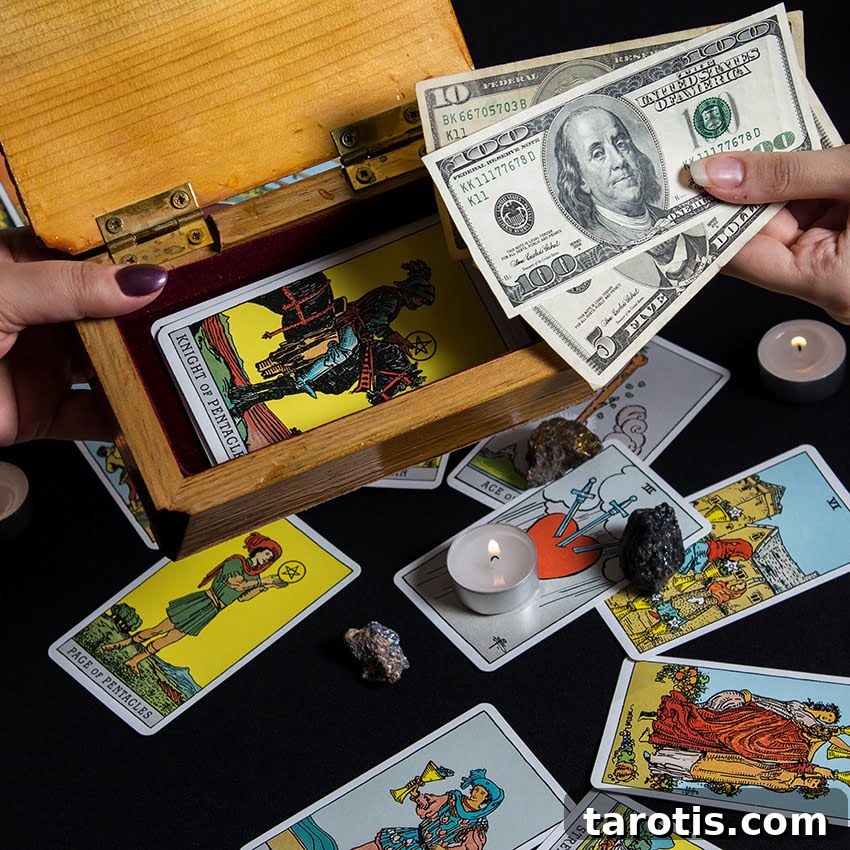
2020 promised to be a year of change for many, with financial security becoming a top priority. In Chinese astrology it was the Year of the Rat, a cycle often associated with wealth, health, and stability. One practical way to work toward better financial footing is to use Tarot as a reflective and strategic tool.
It’s important to be clear: Tarot is not a magic wand that creates instant money. Rather, it offers guidance—helping you see options, obstacles, and actions you can take to improve your financial situation.
Below are practical tips for conducting Tarot readings focused on money and a couple of simple spreads you can use to stay grounded and proactive about finances.
- Keep it simple. If you’re new to Tarot, avoid complex spreads. Tarot readings rely on intuition and knowledge of card meanings, and overly elaborate layouts can create confusion or heighten anxiety—especially when dealing with practical topics like money. Opt for concise spreads that are easy to interpret.
- Watch for pentacles. Pentacles represent the material realm—money, work, health, possessions. A reading with several pentacles often points directly to financial or practical matters. Upright pentacles usually signal stability or progress; reversed cards can indicate blockages. Beginners may want to avoid reversals until they feel more confident.
- Remember everything can change. Tarot shows tendencies, potential outcomes, and choices—not unchangeable fate. If a card points to an unwelcome possibility, it’s often a prompt to take different actions. Advice cards are especially valuable because they suggest constructive steps you can take to alter the path.
Drawing Wealth: Readings
Here are two practical spreads to help you stay aware of your financial situation and work toward greater prosperity. Both are suited to regular practice—weekly or monthly—to monitor shifts and take timely action.
The first is a simple three-card spread ideal for maintaining control of your current finances. It’s quick to perform and highlights potential disruptions so you can prepare.
Question: What will my financial situation this week be like?
- Card 1: The situation
- Card 2: What I should do
- Card 3: What I should not do
Example interpretation:
Card 1: The Tower
The Tower often signals an unexpected event. It need not be catastrophic; it could be a small but unsettling financial surprise, such as an unexpected expense. The card warns you to expect the unforeseen and plan accordingly.
Card 2: 8 of Pentacles
The 8 of Pentacles advises steady effort and focus on work or skill-building. This suggests that consistent effort will help you manage or recover from any disruption.
Card 3: 4 of Cups
The 4 of Cups warns against complacency or indifference. Don’t assume things will resolve themselves—keep engaged with your finances and avoid careless decisions. Combined with the 8 of Pentacles, the message is to continue working diligently and remain alert.
Overall, this spread advises vigilance and sustained effort as the best response to potential short-term surprises.
Read this next: A Guide to the 4 Tarot Suits – Cups, Wands, Swords & Pentacles
The second spread is slightly more detailed and useful when you want guidance on improving your broader financial position.
Question: How can I improve my financial situation?
- Card 1: My situation at the moment
- Card 2: Advice for how to improve it
- Card 3: Advice for how to improve it (additional insight)
- Card 4: Obstacles to watch out for
- Card 5: Overall message
Example interpretation:
Card 1: Strength
Strength suggests you may be facing financial challenges but also highlights inner resilience. This card encourages you to acknowledge your perseverance and to draw on it as you navigate difficulties.
Card 2: King of Pentacles
The King of Pentacles points to practical leadership, stability, and resources. It can indicate a person—perhaps a mentor, partner, or advisor—who can offer tangible help. If this role is unclear, consider seeking clarification through additional cards or reflection.
Card 3: 3 of Wands
The 3 of Wands encourages expansion and initiative. Think beyond your current boundaries: explore new opportunities, be proactive, and use creativity to pursue income or investments. This is a call to plan and take concrete steps toward future growth.
Card 4: 9 of Swords
The 9 of Swords highlights worry and anxiety as major obstacles. Excessive fear can block progress and decision-making. Addressing mindset—through practical planning, stress management, or seeking support—will help you act on the advice cards.
Card 5: The Emperor
The Emperor as the overall message emphasizes taking control. It signals that structure, discipline, and decisive action will empower you to improve your finances. By combining steady effort, practical assistance, and a clear plan, you can build greater stability.
Conclusion
Tarot can be a clear and practical guide for financial matters because its imagery often maps directly onto material concerns. Use these spreads as tools for reflection, planning, and decision-making. They won’t conjure money, but they can point you toward choices and attitudes that attract greater security and opportunity.
Try these readings regularly to track progress, spot pitfalls, and stay focused on concrete steps that support financial growth.
Related Article: Saturn in Aquarius – Make Career Dreams Reality