
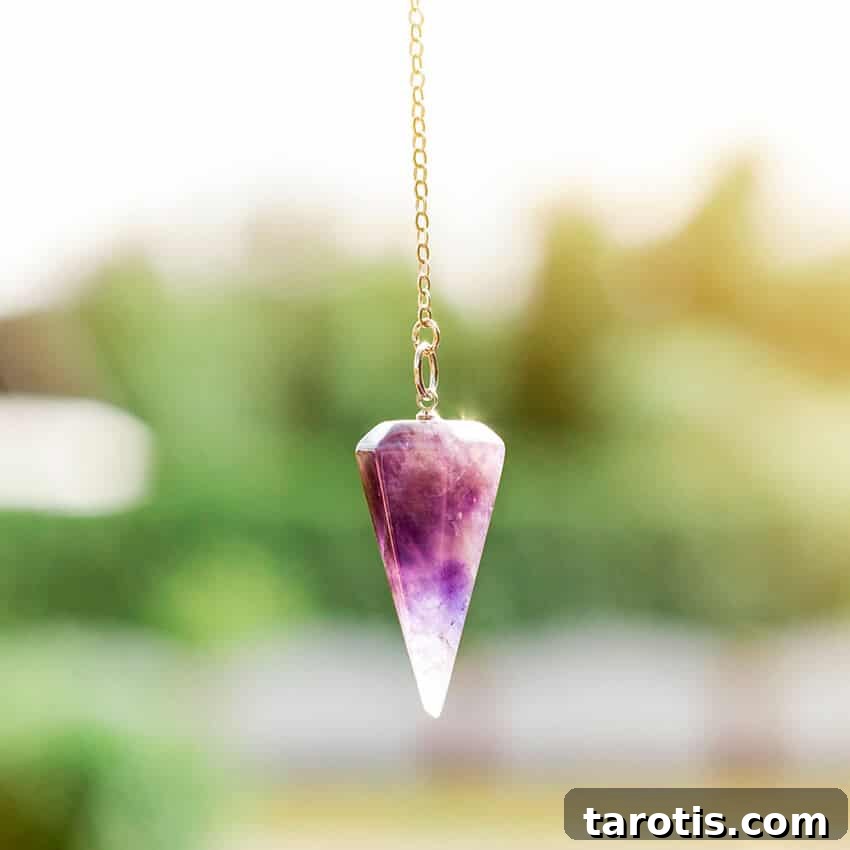
There are many ways to seek answers—from daily horoscopes and numerology readings to Tarot spreads—but one practical divination tool that often gets overlooked is the chakra pendulum. Easy to use and portable, it can offer quick guidance while helping you tune into the energy centers of your body.
This guide explains what a chakra pendulum is and how to use it to get clear, reliable responses to your questions. Follow these steps to build a confident practice and deepen your connection to your chakras.
What is a Chakra Pendulum?
A chakra pendulum is a weighted object on a chain or cord used for divination and energetic work. It’s commonly used to assess and balance the seven main chakras—subtle energy wheels that influence different aspects of your physical, emotional, and spiritual life.
Each of the seven chakras corresponds to particular qualities and areas of experience:
Here’s a brief breakdown of the chakras.
- Root Chakra – At the base of the spine. Governs basic needs and security (food, shelter, stability). Associated color: red.
- Sacral Chakra – Located in the pelvis. Relates to sexuality, creativity, pleasure, and fertility. Associated color: orange.
- Solar Plexus Chakra – Across the upper abdomen. Governs confidence, self-esteem, and personal power. Associated color: yellow.
- Heart Chakra – Center of the chest. Associated with love, compassion, and new beginnings. Associated color: green.
- Throat Chakra – At the throat. Rules communication, truth, and self-expression. Associated color: blue.
- Third Eye Chakra – Between the eyebrows. Governs intuition and inner vision. Associated color: indigo.
- Crown Chakra – At the top of the head. Connects you to spiritual awareness and the Divine. Associated colors: white or violet.
When a chakra feels off—difficulty expressing yourself, low energy, poor boundaries—you can use targeted techniques to restore balance. A chakra pendulum is a hands-on instrument you can use alongside meditation, breathwork, and other energetic practices.
Physically, it looks like a small piece of jewelry: a weighted stone or crystal suspended on a chain. Functionally, it acts like any pendulum: you calibrate it, ask questions, and read its movements as answers. When used over a chakra point during meditation, it can help you sense blockages or alignment.
How to Use a Chakra Pendulum
If you’re new to pendulums, take a few preparation steps to establish a clear, consistent connection. After that, consulting your pendulum becomes a straightforward practice.
Follow these steps to prepare your pendulum and begin working with your chakras.
1. Cleanse the pendulum.
Most pendulums include crystals, which can carry residual energy from previous handlers. Cleanse them before first use so your pendulum responds only to your field. Common methods include soaking overnight in salt water or smudging with sage. Salt removes unwanted ions while sage clears energies quickly—choose the method that feels right for you.
2. Charge your pendulum.
Charging is optional but helpful if you plan regular use. Place the pendulum on a windowsill to absorb sunlight or moonlight for several hours. Leaving it charged when not in use keeps its energy refreshed and receptive.
3. Calibrate your pendulum.
Calibration establishes what motions mean for you. Hold the pendulum steady and ask it to show you a clear response for “no,” “yes,” and “uncertain.” Typical responses might be horizontal for no, vertical for yes, and circular for uncertain, but individual pendulums vary. Spend a minute or two confirming each motion so you and the pendulum speak the same language.
“Uncertain” can indicate a conditional answer or lack of information—treat it as a prompt to rephrase the question or gather more facts.
4. Ask your questions.
Now you can begin asking questions. Aim for clarity and specificity, and prefer yes/no questions when possible. Examples: “Should I pursue this opportunity?” or “Will this decision have a positive outcome?” If you receive many uncertain responses, refine the wording or break complex issues into smaller questions.
5. Follow the flow.
Pay attention to how the process feels. Your intuition and bodily sensations often confirm what the pendulum communicates. A sense of ease suggests alignment with the guidance; discomfort may signal the need for more information or healing work. Use those physical and emotional cues alongside the pendulum’s motions to build a fuller understanding.
Combine pendulum sessions with complementary practices—meditation, journaling, Tarot, or horoscopes—to cross-check insights and deepen your perspective.
Embrace Your Chakra Pendulum
A chakra pendulum is a supportive tool, not a substitute for evidence-based decision making. Use it regularly to fine-tune your energy and gain clarity, but confirm important choices with facts and trusted counsel.
Approach each session with clear intention and a heart aimed toward your highest good. Over time, you’ll develop a reliable rapport with your pendulum and a keener sense of which chakras need attention. Start small—pick one chakra to explore today—and let the practice grow into a steady resource for balance and insight.