
Do you skim horoscopes or sign-based articles and think, “That isn’t me at all”? If so, a couple of things are likely true:
- You probably have a different Rising (Ascendant) sign and Moon sign
- You’re ready to get your birth chart done
Astrology is layered. Your Sun sign is only the surface of a much more detailed map of personality. Many people dismiss horoscopes as vague or wonder how 12 signs could cover everyone. The reality is that a single birth date gives only a small piece of the puzzle.
Daily horoscopes typically summarize broader patterns for each Sun or Moon sign, but a full birth chart—also called a natal chart—captures the exact configuration of planets, signs, and houses at the moment and place of your birth. Those combinations reveal subtleties that a generic horoscope cannot. That’s why two people with the same Sun sign can feel completely different.
Think of astrology like a set of nested dolls: the more layers you explore, the closer you get to what’s unique about you.
What Is a Birth Chart and What Can It Tell Me?
A birth chart is essentially a snapshot of the sky at the exact time, date, and location of your birth. It shows where the planets and zodiac signs were positioned and which astrological houses they occupied. This snapshot provides far more nuance about your personality than your Sun sign alone.
Birth charts can reveal:
- You have more than one influential sign (Sun, Moon, Rising)
- Which houses and signs your planets occupied at birth, offering specifics about how you express traits
- How you behave in love and what attracts you
- Areas of life where you’re likely to find career success
- Your key strengths and potential challenges
Birth charts will not:
- Name the exact person you’ll marry
- Spell out every event that will happen in your life in chronological order
That’s why accurate birth time and location matter to astrologers: they allow the creation of a precise natal chart, a detailed map of planetary positions at your moment of arrival.
Your Primal Triad
The Primal Triad consists of three core placements: the Sun, the Moon, and the Rising (Ascendant) sign.
– The Sun sign is where the Sun was at your birth and represents your core identity and conscious self.
– The Moon sign reflects your inner world—emotions, instincts, and how you process feelings.
– The Rising or Ascendant sign is the zodiac sign on the eastern horizon at birth. It shapes the first impression you give others and the persona you present in public.
People often experience an “aha” when they discover their Rising or Moon sign because those placements can explain why others don’t “read” them as their Sun sign. If two of these signs match, a person is often described as a double sign; if all three match, a triple sign.
Because planetary positions change constantly, even a small difference in birth time can alter your Moon or Rising sign. Astrology works in degrees and moments, so precision matters.
The Astrological Houses
The birth chart wheel is divided into 12 houses, each governing a distinct life area. The signs and planets that occupy each house color how those life areas manifest.
- 1st House (Self & Ego / Rising Sign) – How you appear to others, your outward personality and approach to life.
- 2nd House (Wealth & Values) – Money, possessions, values, and how you use your talents to earn a living.
- 3rd House (Communication, Travel & Learning) – How you think, learn, and communicate; short trips and sibling relationships.
- 4th House (Family & Home) – Roots, family life, emotional foundations, and the structure you need.
- 5th House (Pleasure & Creativity) – Romance, hobbies, creative expression, and what brings joy.
- 6th House (Health & Routine) – Daily habits, wellness, service, and work environment.
- 7th House (Partnerships) – Committed relationships, how you relate to others one-on-one, and important alliances.
- 8th House (Transformation) – Shared resources, intimacy, rebirth, and deep psychological shifts.
- 9th House (Philosophy & Long Travel) – Beliefs, higher learning, long-distance travel, and exploration of meaning.
- 10th House (Career & Public Status) – Vocation, reputation, and your role in the wider community.
- 11th House (Friendships & Groups) – Social networks, groups, hopes, and collective goals.
- 12th House (Endings & the Hidden) – Hidden matters, unconscious patterns, fears, and undiscovered gifts.
Not every house will contain a planet or sign in your chart, and some houses may be heavily occupied. Three or more planets clustered in a single house form a stellium, highlighting a major area of focus in your life.
For instance, Sagittarius on the 10th house cusp suggests a career path that may span different fields, driven by curiosity and the desire for growth and variety rather than a single stable job title.
Planets and Zodiac Signs in the Birth Chart
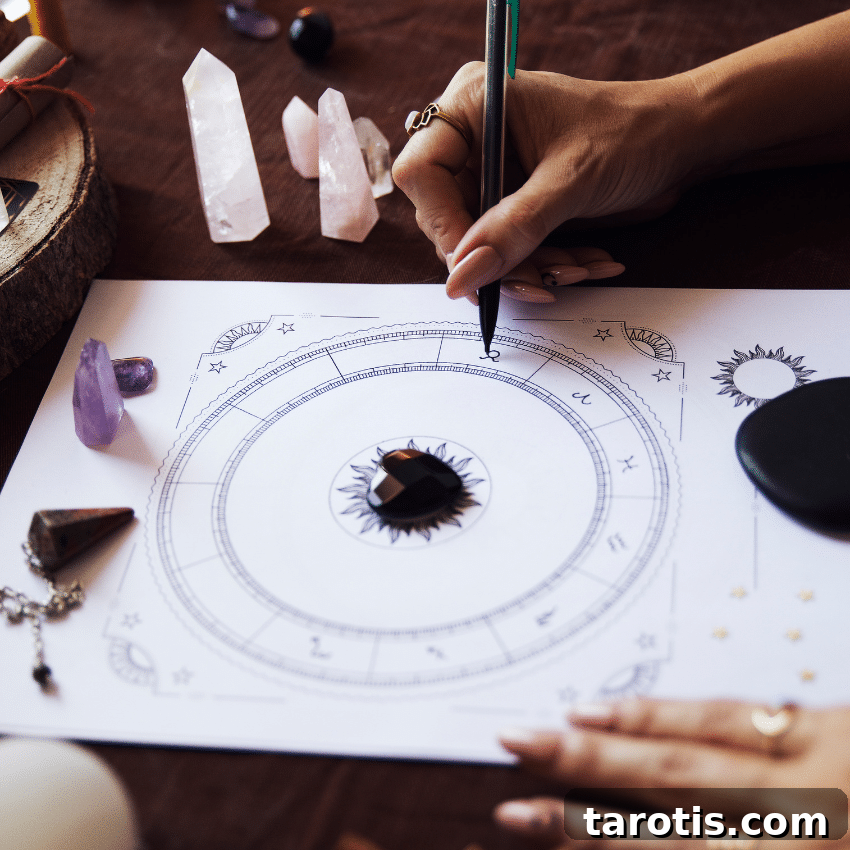
A natal chart looks like a 12-slice pie. The outer ring shows the zodiac signs, the inner ring the astrological houses, and planet symbols fall into specific slices, indicating how and where their energy expresses in your life.
Planets move at different speeds: the Moon changes signs every few days, Mercury moves through a sign in a few weeks, while outer planets like Uranus and Pluto linger for years. Those slow-moving planets often shape generational influences, while personal planets create individual patterns.
Each planet rules distinct life functions. For example, Mercury governs communication—if Mercury is in Leo, you likely communicate with warmth, drama, and confidence. Jupiter in Virgo suggests growth and luck come through careful attention to detail and steady work.
- Sun – Identity and ego
- Moon – Emotions and instincts
- Mercury – Thinking and communication
- Venus – Love and attraction
- Mars – Drive, courage, and assertion
- Jupiter – Expansion, opportunity, and belief
- Saturn – Discipline, structure, and responsibility
- Uranus – Innovation and rebellion
- Neptune – Imagination, intuition, and healing
- Pluto – Power, transformation, and regeneration
How these planets interact with signs and houses, along with their aspects and angles, reveals opportunities, tensions, and themes. Advanced techniques and transit analysis add more depth for timing and growth, but those topics go beyond this introduction.
Relationships and Your Birth Chart
A natal chart won’t name your future spouse, but it does clarify the type of partner you attract and the patterns you bring into relationships. Venus, the 5th house (romance), and the 7th house (partnerships) are particularly informative.
For singles, your chart can highlight traits to look for in a partner and traits to avoid. For those in relationships, synastry—comparing two natal charts—reveals compatibility, friction points, and how to strengthen the bond. If you keep clashing over communication despite a seemingly good zodiac match, check the charts for 3rd-house placements (communication) or 7th-house dynamics (relationships) for deeper insight.
Career, Money, and Financial Patterns
Examining the 2nd (money), 6th (work habits), and 10th (career) houses helps you identify career directions and financial tendencies. Astrology won’t hand you a specific job title or lottery numbers, but it can reveal your strengths, work style, and where money opportunities are likely to arise.
For example, placements that indicate strong communication skills could be expressed across many professions—teaching, writing, PR, translation, counseling—depending on your interests. The chart highlights how you work and how you can best apply your talents for success.
A chart may also show tendencies like financial caution or impulsiveness, the potential for inheritances, or cycles of gain and loss. That insight can help you plan realistically for stability and growth rather than rely on quick fixes.
Health Clues from Your Birth Chart
Astrology is not a substitute for medical advice. Astrologers are not doctors, and natal charts should never replace professional healthcare. However, charts can suggest areas of the body or systems that may need attention and indicate tendencies such as susceptibility to stress, inclination toward alternative healing, or patterns that affect wellbeing.
Signs have traditional bodily associations, and planetary placements or challenging aspects in the 6th house (health) can point to areas where you might benefit from extra care or preventive practices.
Use Your Natal Chart to Learn About Yourself
A birth chart holds many clues about your personality, motivations, and life themes. Digging beyond your Sun sign provides a richer, more nuanced understanding of who you are. The more you explore your chart, the better you can direct your energy in relationships, career, and health.
Interpreting a natal chart well takes skill and experience, which is why professional astrologers charge for readings. A thoughtful chart analysis can highlight what stands out and offer practical ways to apply that knowledge in daily life.
If you haven’t had your chart calculated yet, consider getting your birth time and place and exploring the details—there’s a lot to discover.