
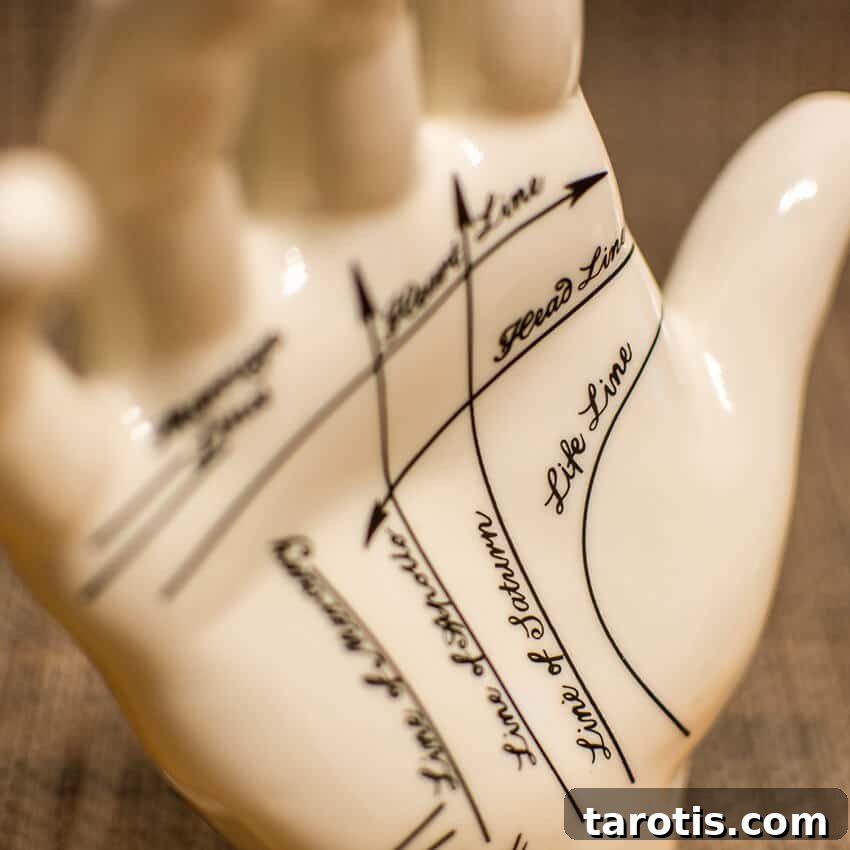
The art of palmistry, also known as chiromancy, has existed for thousands of years as a method of divination used to explore a person’s potential and personality. By examining the shape of the hand, the length and form of the fingers, and the lines on the dominant palm, an experienced reader interprets traits related to character, relationships, and life patterns.
Learning palmistry begins with the basics. A good starting point is to understand the three primary lines commonly analyzed: the heart line, the head line, and the life line. These lines are read on your dominant hand and can reveal tendencies rather than fixed destiny.
The Heart Line
The heart line is the uppermost major line on the palm, located closest to the fingers. It represents emotions, intimacy, and the way you love and relate to others. Because palm reading follows the “as above, so below” principle, the heart line can also reflect how you love yourself and how that self-regard influences your relationships.
A long, deep, and curved heart line typically signals strong emotional depth and potential for lasting relationships. Conversely, a shorter, straighter, or shallower heart line often points to a more practical, less emotionally driven approach to relationships and may suggest that romantic connections tend to be briefer. A faint or indistinct heart line can indicate that romantic goals are not central in your life.
When the heart line is straight and firm, the reader may interpret this as a tendency to prioritize analysis over feeling and to maintain emotional control. A pronounced curve usually points to passionate feelings and greater emotional expressiveness. Breaks or interruptions in the heart line can suggest periods when you put others before yourself; multiple breaks may be a sign to prioritize self-care more consistently.
The Head Line
The head line lies beneath the heart line, starting roughly between the base of the thumb and index finger and stretching across the palm toward the little finger. It offers insight into your thinking style, learning preferences, and intellectual tendencies.
A curved head line often indicates an intuitive, emotionally attuned thinker, while a straight head line suggests a pragmatic, analytical mind. The length of the head line can represent how broad or focused your intellectual interests are: a longer line suggests curiosity across many subjects, while a shorter line may indicate concentration on a few areas of expertise.
Depth matters as well: a deep, clear head line is typically associated with serious, complex thinking and a tendency toward deep study, whereas a shallower line suggests a lighter, more easygoing approach to intellectual matters. The head line can change over time with life experiences and conscious intention—career shifts, health challenges, or new passions may reshape how and what you choose to learn, so view this line as expressing tendencies rather than fate.
The Life Line
The life line is the curved, semi-circular line that arcs around the base of the thumb. Although commonly misunderstood as a measure of lifespan, the life line actually reflects vitality, general energy levels, adaptability, and the way you respond to life’s changes.
If the life line arcs far toward the center of the palm, it often denotes robust, ambitious energy. A life line that stays close to the thumb indicates a more receptive, steady temperament that goes with the flow. Where the line begins also matters: a line that starts higher on the palm near the index finger suggests an active, initiative-taking personality; if it begins lower, nearer the thumb, it suggests a more adaptable, go-with-the-flow disposition.
Depth and continuity provide additional clues. A deep, well-defined life line suggests sustained vitality and intense engagement with life; a shallow line may point to a need for frequent rest and recharge. Breaks or interruptions can signal significant transitions, challenges, or transformative events. Shorter life lines can indicate susceptibility to outside influence, while longer lines may suggest strong leadership tendencies. As with other palm lines, the life line can evolve over time as your energy, health, and choices change.
Final Thoughts on Palm Reading
Palmistry is an intuitive, subjective art that improves with practice. The hands reveal subtle information for those who learn to observe and interpret variations in lines, mounts, and shapes. Compare your palm with those of friends and family, and practice noticing differences and patterns to refine your reading skills.
Remember that palm lines describe tendencies and potentials—not rigid destiny. You can influence how your life unfolds by directing your energy intentionally. The palms offer a dynamic map that shifts as you grow, make choices, and respond to circumstances. With patience and attention, palmistry can become a useful tool for self-awareness and conscious personal development.