
Have you heard the terms natal chart or birth chart recently? What is your first reaction when you hear them?
Maybe you’re thinking— “Birth chart? What is that?”
Or perhaps you’re already familiar with astrology and excited to go deeper because you know how to read a chart.
Wherever you stand, this article will demystify natal charts and explain the basics in clear, practical terms so you can start reading your own chart with confidence.
Ready to see yourself from a new perspective?
Consider this an invitation to explore how astrology can reveal patterns in your personality, relationships, and life purpose.
Let’s begin.
What is an Astrological Birth Chart?
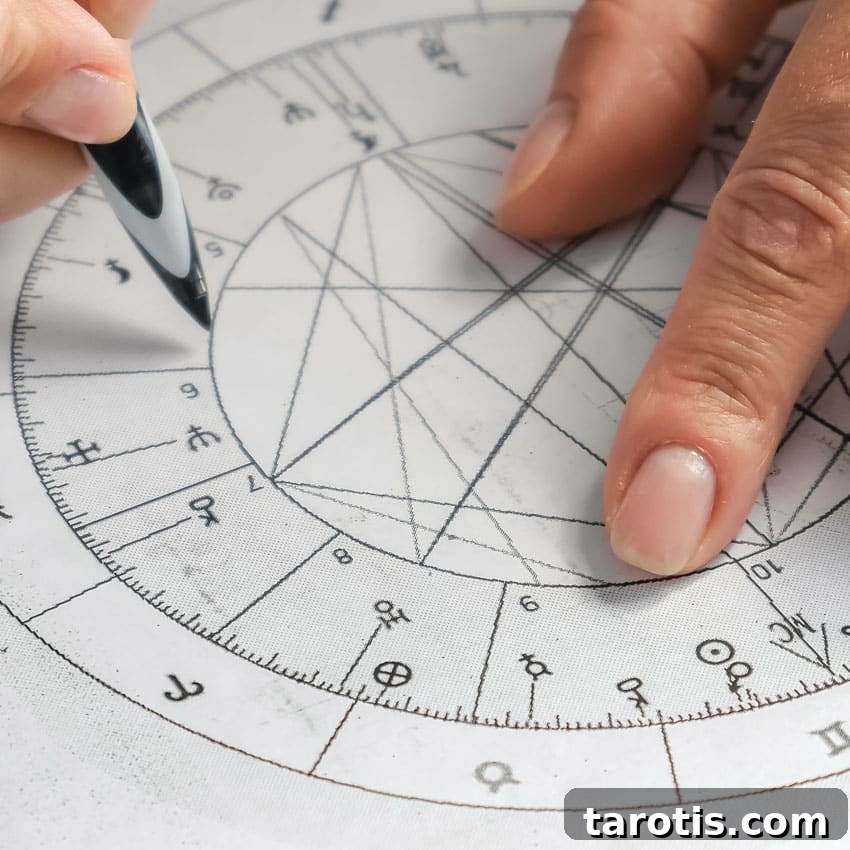
A birth chart, or natal chart, is a map of the sky at the exact moment and place you were born. To create an accurate chart you need your birth date, exact time, and birthplace.
Graphically, a birth chart is a 360-degree circle divided into 12 sections that correspond to the zodiac signs. Each zodiac spans 30 degrees and the precise degree positions of the planets indicate where they were located at your birth.
The main components of a natal chart include:
- 12 zodiac signs
- The Rising sign or Ascendant
- Astrological houses
- Exact planetary positions
- Aspects between planets
Once you become familiar with these pieces, the chart starts to feel much more approachable.
Why Reading Your Birth Chart Is Useful
A birth chart is a tool for self-awareness. Reading it can help you:
- Gain a clearer understanding of your personality and motivations
- See recurring patterns in relationships and career
- Identify strengths, challenges, and areas for growth
- Clarify your values, desires, and what truly matters to you
- Understand emotional habits and inner needs
- Explore potential life purpose or soul lessons
While astrology is not a deterministic blueprint, the chart offers a symbolic language to interpret tendencies and potentials in your life.
How to Read a Birth Chart
A useful starting point is the “Primal Triad” or “Big Three”: the Sun sign, Rising sign (Ascendant), and Moon sign. These three placements provide a foundation for understanding core identity, outward style, and emotional life.
Sun Sign
The Sun represents core identity, vitality, and conscious self-expression. Your Sun sign points to the qualities you develop and the themes you identify with most strongly.
Rising Sign
The Rising sign, or Ascendant, reflects how you present yourself to the world and how others perceive you. It marks the start of the first house and influences your outward manner and approach to life.
Moon Sign
The Moon governs emotions, instincts, and inner needs. Your Moon sign describes emotional patterns, what makes you feel secure, and how you process feelings.
Venus Sign
Venus relates to relationships, values, pleasure, and aesthetics. Your Venus placement reveals how you give and receive affection, what you value in partnerships, and your approach to money and beauty.
Saturn Sign
Saturn represents discipline, responsibility, and limits. Its placement highlights where you must develop structure, patience, and long-term effort—often pointing to life lessons that require maturity.
Other Planetary Placements
Each planet adds a layer to the personality:
- Pluto indicates areas of deep transformation and regeneration.
- Uranus shows where you challenge convention and innovate.
- Neptune points to imagination, creativity, and spiritual longings.
- Mercury describes communication style and thought processes.
- Mars highlights drive, assertion, and how you pursue goals.
- Chiron reveals wounds and where healing work is needed for growth.
Planetary Aspects
Planets form geometric angles to each other called aspects (conjunctions, trines, sextiles, squares, oppositions). These aspects show how planetary energies interact—supporting, challenging, or blending with one another. Reading aspects is essential to understand the dynamics inside a chart.
Your 10-Step Guide to Reading a Birth Chart
- Find your Ascendant (Rising sign) and note its traits.
- List the personality qualities associated with the Ascendant.
- Do the same for your Sun and Moon signs.
- List qualities for each planet’s placement and the house it occupies.
- Combine the planet’s meaning with its sign and house to refine interpretation.
- Note Chiron’s placement to identify core wounds and healing themes.
- Locate the North Node (Rahu) and South Node (Ketu) and their houses.
- Consider what the nodal axis suggests about your soul’s direction and past-life talents.
- Map major planetary aspects—conjunctions, oppositions, squares, trines, and sextiles—and interpret how they shape expression.
- Integrate everything: what do these placements and patterns indicate about your relationships, family values, finances, career, lessons, and purpose?
Example:
Imagine a chart where Jupiter sits in Cancer in the first house, opposite Saturn in Capricorn. The North Node is in Virgo in the third house, and the South Node is in Pisces in the ninth house. Breaking this down:
- Jupiter: themes of teaching, philosophy, and abundance.
- First house: self-expression, appearance, and personal identity.
- Cancer: nurturing, emotional sensitivity, and protection.
- Jupiter opposite Saturn: expansion tempered by discipline and practical obstacles.
- North Node in Virgo (3rd house): soul growth through service, communication, and practical skills.
- South Node in Pisces (9th house): past-life comfort with spirituality and creative insight.
Putting this together suggests a person with natural spiritual insight and strong nurturing instincts who is meant to develop practical communication skills—perhaps sharing spiritual teachings through writing or online platforms. Their journey may require adding structure and discipline to their creative impulses to realize their purpose.
Understand Yourself Through Your Birth Chart
In summary, a birth chart is a symbolic map that can illuminate your strengths, challenges, and potentials. Learning the basics—signs, planets, houses, and aspects—gives you the tools to begin meaningful self-inquiry. While this overview won’t make you a professional astrologer overnight, it offers a solid starting point for personal insight and growth.
Reading your chart can deepen self-understanding and help you make more conscious choices. If something in your chart surprises you, reflect on it and notice how those themes show up in your life.
Share what you discover about your birth chart—what revelations surprised you most?