
Let’s be clear: being alone on Valentine’s Day is perfectly fine. In many ways it’s an opportunity to explore self-love, nurture your own company, and enjoy the freedom to prioritize your well-being.
If you’re spending Valentine’s Day solo, this guide will help you cultivate positive feelings and fall in love with yourself. Using Tarot as a reflective tool, you can gain clarity, direction, and encouragement. You don’t even need a physical deck—online three-card readings work well for this practice.
Let’s begin.
Step 1: Formulate a Positivity-Focused Question
Experienced Tarot readers emphasize that the quality of your question determines how useful the reading will be. Shuffling and pulling cards without an intention often produces vague or confusing results. When you clarify what you want—how you’d like to feel or what you hope to change—the Tarot can highlight practical ways to move toward that state.
Having a sense of the emotional shift you want—for example, moving from loneliness to self-appreciation—helps the cards provide relevant guidance.
Sample questions to ask the Tarot on Valentine’s Day include:
- What can I release to feel more positive?
- What should I focus on to lift my spirits?
- How can I feel more confident in myself?
Take time to refine your question before you begin. Clear intention produces clearer insights that you can act on.
Step 2: Let the Tarot Cards Guide You
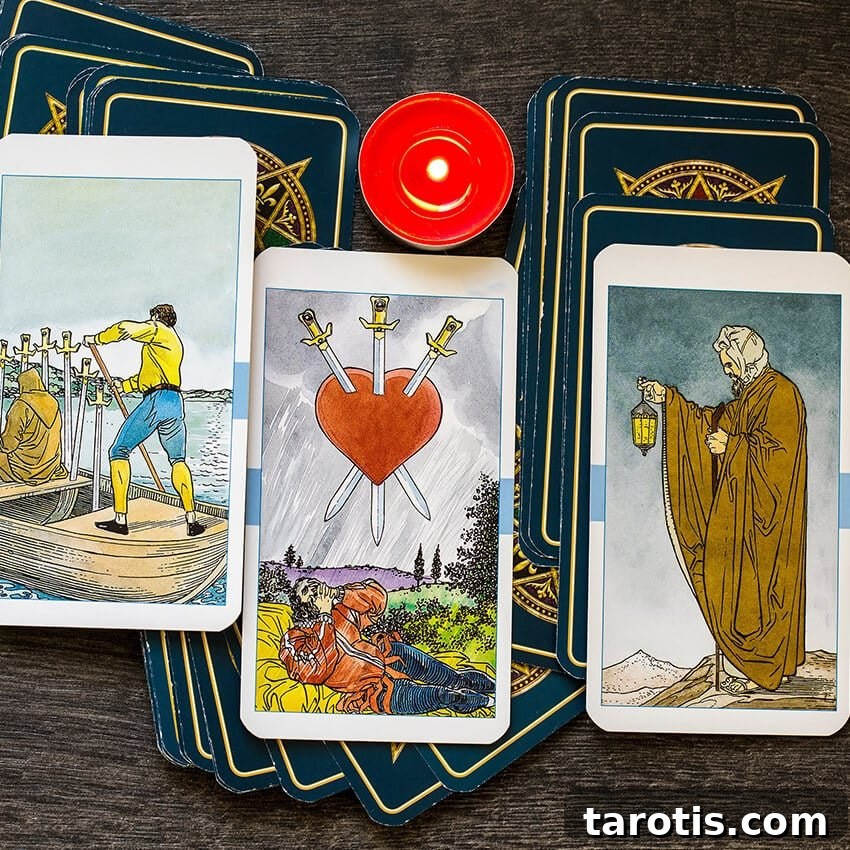
Choose a Tarot spread that suits your comfort level. A simple past-present-future three-card spread is an excellent way to see patterns and possibilities related to your question.
In a past-present-future spread, the first card reflects past influences, the second reveals your current state, and the third suggests how to direct your energy for the future. This reading is empowering because it frames your future as something you’re actively creating—by becoming aware of your present energy, you can shift it intentionally.
Interpret each card in relation to your question. Journaling your reading—recording the date, your question, the cards drawn and their positions, and any impressions or feelings—helps deepen understanding and offers a reference you can revisit later.
Many newcomers find Tarot more accessible than expected. Trusting your intuition during a reading often reveals pathways to joy that come from within. Relax, allow the cards to speak, and listen to the inner responses that arise. Tarot can open a channel of self-trust, helping you reconnect with your authentic source of happiness.
Step 3: Ask a Follow-Up Question
One reading frequently leads to another question. If new curiosities arise, don’t hesitate to draw a clarifying card or ask a focused follow-up.
For example, if the 3 of Cups appears and suggests surrounding yourself with joyful people, pull an extra card to clarify what activity would uplift you or which friends would be good company. Sometimes spending time with someone unexpected delivers exactly what you needed.
Write down your follow-up question and note the insights that emerge from the clarifying card. These additional details can help you create a concrete plan for bringing positivity into your Valentine’s Day.
Concluding Thoughts
Spending Valentine’s Day alone can be a meaningful time to practice self-love and claim your personal power. Tarot helps you hear your inner voice more clearly, revealing the acceptance and joy that already exist within you.
While Tarot is sometimes seen only as a tool for predicting outcomes or reading others, its deeper value lies in guiding personal transformation. Use the cards to shape your own thoughts and emotions, rather than attempting to control someone else. When you take responsibility for your energy and intentions, you gain the capacity to attract positive experiences and transform your life.
Related Article: How To Use Today’s Horoscope As The Ultimate Stress Reliever