
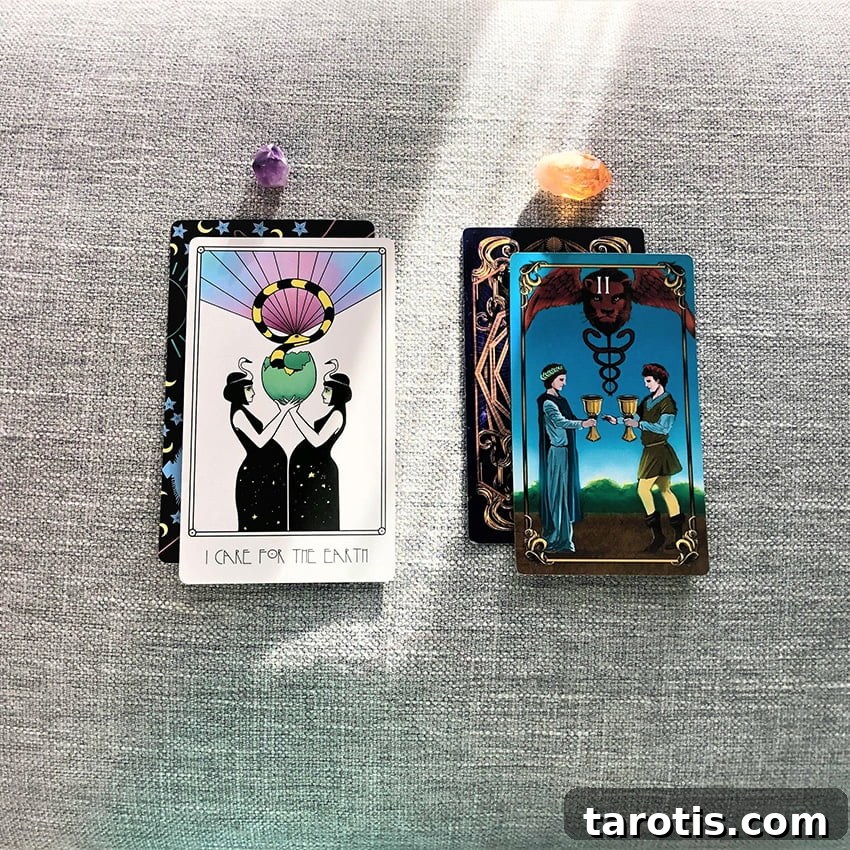
Everyone loves the Tarot, a time-honored system wrapped in charm and mystique. But what about its more free-form counterpart — the Oracle deck? Below we outline the key differences between Tarot and Oracle decks, and offer guidance to help you decide whether to try one, the other, or both.
Let’s Talk Tarot
A Tarot deck is typically a 78-card deck that follows a consistent structure. It comprises the Major Arcana and the Minor Arcana and maps archetypal stages, emotions, and events of human life. Cards such as the Three of Swords can indicate heartbreak, while cards like The Star suggest healing and renewal.
The Minor Arcana traditionally contains four suits—Wands, Pentacles, Cups, and Swords—which are often aligned with the elements of Fire, Earth, Water, and Air. While artists sometimes reimagine suit names, the essential symbolism and narrative through-line of Tarot usually remain intact. That consistent framework is what makes Tarot relatively straightforward to learn and easy to apply across different decks.
What about Oracle?
Oracle decks are far less regimented. They can contain any number of cards and follow a single theme or no theme at all. Some Oracle decks are tightly focused—on moon cycles, animals, or specific guidance—while others are broad or intentionally eclectic. This flexibility is part of the appeal: each Oracle deck is its own creative expression and may use unique symbolism, language, and tone.
Because Oracle decks vary widely, learning the meanings in one deck doesn’t automatically translate to another. That variability can be a challenge, but it also offers freedom for those who prefer a looser, more intuitive approach than Tarot’s established system.
So, Which is Better?
When Should You Use The Tarot?
Tarot is especially useful when you want structure, clarity, and a method for exploring past, present, or future circumstances. Its built-in archetypes and suits help reveal underlying emotions, motivations, and the dynamics between people. Many readers use Tarot spreads to focus a reading and to address specific questions or life areas. The consistent framework of Tarot makes it easier to switch between decks while retaining a baseline understanding of card meanings.
Tarot readings tend to be more objective and narrative-driven, offering insight into situations and how they may unfold. If you want a systematic tool for exploration and analysis, Tarot is an excellent choice.
When Should You Use Oracle?
Oracle decks often offer a more nurturing, uplifting voice. They frequently deliver direct advice, affirmations, and encouragement, making them ideal for moments when you want reassurance or guidance phrased in a compassionate way. Because Oracle cards vary so much in style and intent, you can choose one that resonates emotionally or spiritually with you.
Oracle and Tarot can complement each other: you might use a Tarot spread for detail and then draw one or two Oracle cards for final affirmations or practical advice. Combining both approaches allows you to benefit from Tarot’s structure and Oracle’s inspirational tone.
A Final Reminder
Choosing a deck is not an either-or decision. You might begin with a Tarot deck and later explore Oracle decks, or start with both. The most important factor is whether a deck speaks to you personally, regardless of system or structure. Both Tarot and Oracle decks can deepen your intuition, clarify questions, and support your personal growth. Trust your connection to the cards and enjoy the journey.