
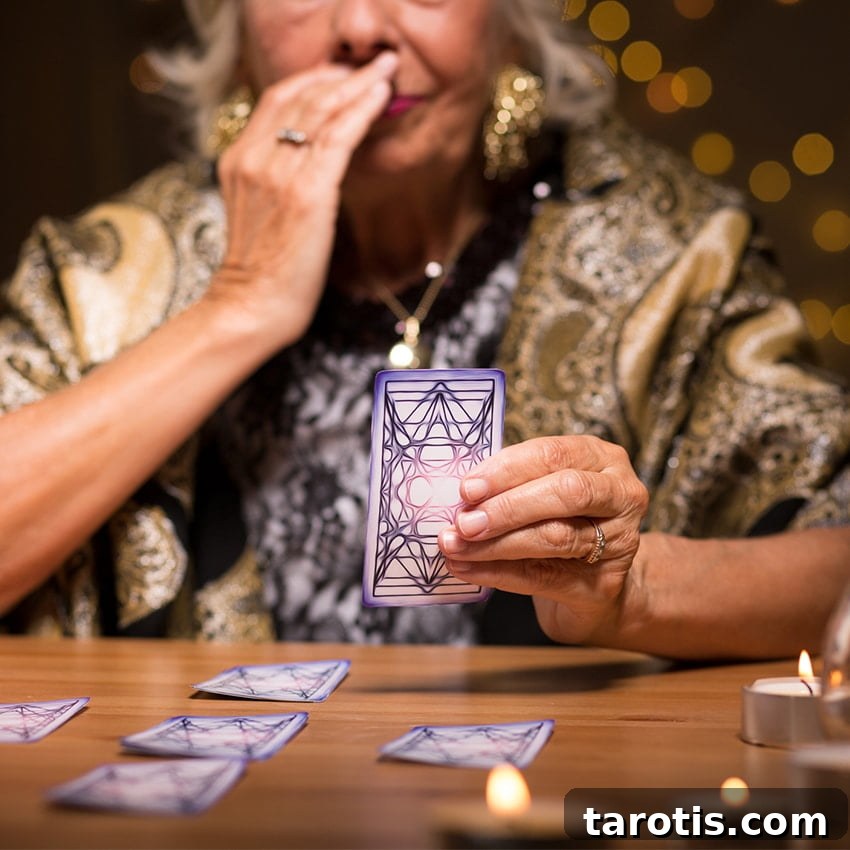
To conduct a tarot card reading, you should understand the most common spreads. Every tarot reading begins with a spread or layout, and each position in a spread carries a distinct meaning. The combination of placement and card symbolism is what allows a reader to interpret the insights and guidance the cards reveal.
A spread examines a specific aspect of the question posed. Spreads are not random; each position refines the focus of the reading and directs how the cards’ messages are applied to the situation.
There are hundreds of tarot spreads, from a single-card draw to complex layouts that provide detailed information about a situation or question. Many experienced readers design their own unique spreads tailored to their style. Below are some of the most popular spreads used by tarot readers so you can begin to use them as well.
One-Card Layout
The one-card layout offers a concise snapshot of guidance for a particular situation. It’s ideal when you want clarity on a single aspect or a straightforward answer without unnecessary detail.
This layout is also often used in sequence: drawing one card after another to reveal a developing story or a series of related insights.
Two-Card Layout
The two-card layout is useful for comparing options or answering either/or questions. One card can represent one choice and the other card the alternative, helping you weigh options and potential outcomes.
It also works well for yes/no questions and for assessing timing—use the two cards to compare two periods or moments to determine which is more favorable.
Three-Card Layout
The three-card spread is extremely popular because it is versatile. The most common interpretation maps the cards to past, present, and future, but positions can also represent a problem, its influences, and possible solutions or obstacles.
This layout can be adapted to different time frames—last week, this week, and next week; or last month, this month, and next month—and other meanings depending on the reader’s intent. Decide what each position represents before placing the cards to ensure a clear interpretation.
Related Article: How to Do Your Own 3-Card Tarot Reading
Five-Card Layout
A five-card spread offers more depth and can illuminate areas related to health, well-being, or balance across several life domains. One popular approach assigns each card to one of the five elements—air, earth, water, fire, and spirit—revealing which areas need attention based on the cards in those positions.
Positions in a five-card spread can also represent mental, physical, emotional, temperament, and spirit, or they can map to a sequence of days, weeks, or months for short-term forecasting. The added cards permit a richer, more nuanced reading.
Celtic Cross
The Celtic Cross is one of the most widely known and frequently used spreads. Despite myths that surround it, the spread itself is a practical and comprehensive layout. Its positions cover the querent’s current circumstances, strengths and resources, obstacles and challenges, and past and present influences.
Used skillfully, the Celtic Cross reveals what to focus on, how to approach a situation, what the querent hopes for, and the potential outcome. Its structure conveys a lot of information in a systematic way, which is why many readers rely on it.
Conclusion
There are as many ways to lay out and interpret tarot cards as there are decks and readers. The most important factor in getting value from a reading is the connection between querent and reader: choose a reader you resonate with who works with empathy, clarity, and integrity.
If you are a reader, select a deck that speaks to you and a spread that feels natural while still yielding meaningful insight. There is no single correct template for arranging the cards—try different popular spreads to discover which give you the clearest and most useful information.
Related Article: How to Read Tarot Reversals