
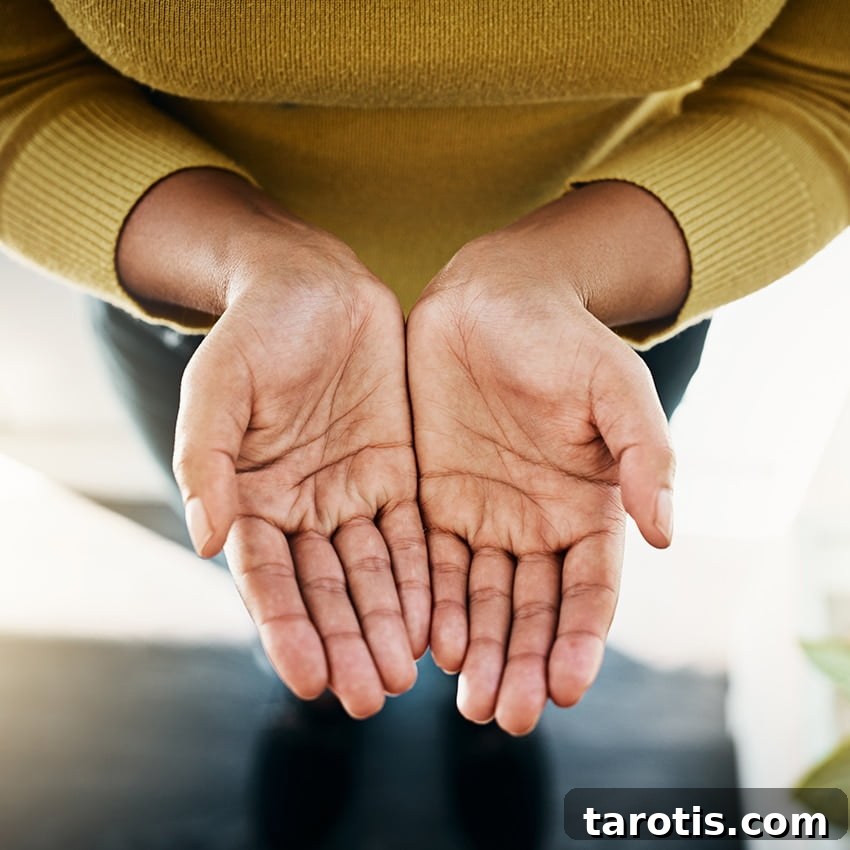
If you’ve been following our palmistry series, you already know the basics of what palmistry is and what to expect from a professional reading. Perhaps you’ve decided a formal session isn’t necessary, or you’d like to practice readings more often at home. If so, it’s time to learn how to read your own hands.
Chiromancy can be a helpful tool for gaining clarity about your life path and healing unresolved issues. Like any new practice, it helps to have reliable resources. Consider acquiring a thorough guide to palmistry if you plan to make your own readings a regular practice.
Below we’ll cover the main features of the hand and what common interpretations can reveal about personality and tendencies.
Picking the Right Hand — or the Left!
Before you begin a reading, decide your intention: are you exploring past influences or looking for guidance about the future? Which hand you examine will make a difference.
Many palmistry practitioners consider the dominant hand to reflect your conscious self and your path forward — the hand that shows what you’re actively creating in life. The non-dominant hand is often seen as the repository of the innate self: subconscious drives, natural inclinations, and sometimes traces of past trauma or early life influences. Choose the hand that matches the perspective you want to explore.
The Four Elements of Palmistry
After choosing a hand, study its overall shape before you analyze the lines. Observe the palm’s proportions and the length and shape of the fingers. In palmistry there are four primary hand shapes that correspond to the classical elements: Earth, Air, Fire, and Water. These elemental hand types describe characteristic approaches to life and temperament, and they don’t necessarily have to match your astrological element.
- Air hand: Typically elegant and delicate, an Air hand has a square palm and long fingers, with pronounced knuckles and thinner digits. The skin tends to be dry and soft. People with Air hands are often curious, analytical, and skilled communicators. They can also be easily distracted and prone to boredom.
- Earth hand: Earth hands are sturdy, with square palms and shorter fingers. The flesh is often firm and the skin coarser and warm to the touch. Those with Earth hands usually approach life practically, reliably, and methodically. They can sometimes be resistant to change or overly fixed in routine.
- Fire hand: Recognizable by a longer palm and shorter fingers, Fire hands often appear bold or almost childlike. The skin is typically dry and the lines deep. Fire-handed people tend to be energetic, confident, and driven. Their directness can occasionally be perceived as bossiness or impatience.
- Water hand: Water hands are long and narrow, with slender fingers and softer, slightly moist skin. People with Water hands are frequently intuitive, empathetic, and imaginative. Their sensitivity fuels creativity but can also make them vulnerable to hurt or offense.
Some individuals may show different elements in each hand. That divergence often signals a shift between an earlier, innate disposition and a later, developed personality — perhaps the result of a significant life event that redirected behavior or priorities. For example, your non-dominant hand might reflect an impulsive, fiery nature while your dominant hand displays steadier, earth-centered traits. If you notice such a contrast, reflect on life events that could explain the transformation.
It’s All Natural — or Is It?
When practicing palmistry, include features that developed over time: scars, calluses, blisters, and birthmarks can all carry meaning. Scars point to specific life experiences that may have influenced personality, while calluses indicate repeated actions or habits. A mole or birthmark on a significant line can draw attention to that area’s influence in your life. These acquired marks help tell the story of how experience shapes character.
Parting Thoughts
There’s much more to discover beyond hand shape alone — the contours, mounts, and lines all add layers of meaning. In a future article we’ll explore the individual lines and mounts in greater detail. If you want to learn palmistry seriously, spend time getting intimately familiar with your hands: notice what you do with them every day, the objects you interact with, and how repeated actions leave marks. Those everyday activities, and the marks they leave, shape you just as you shape them.
Related Article: Palmistry: What Do Your Fingers Represent?