
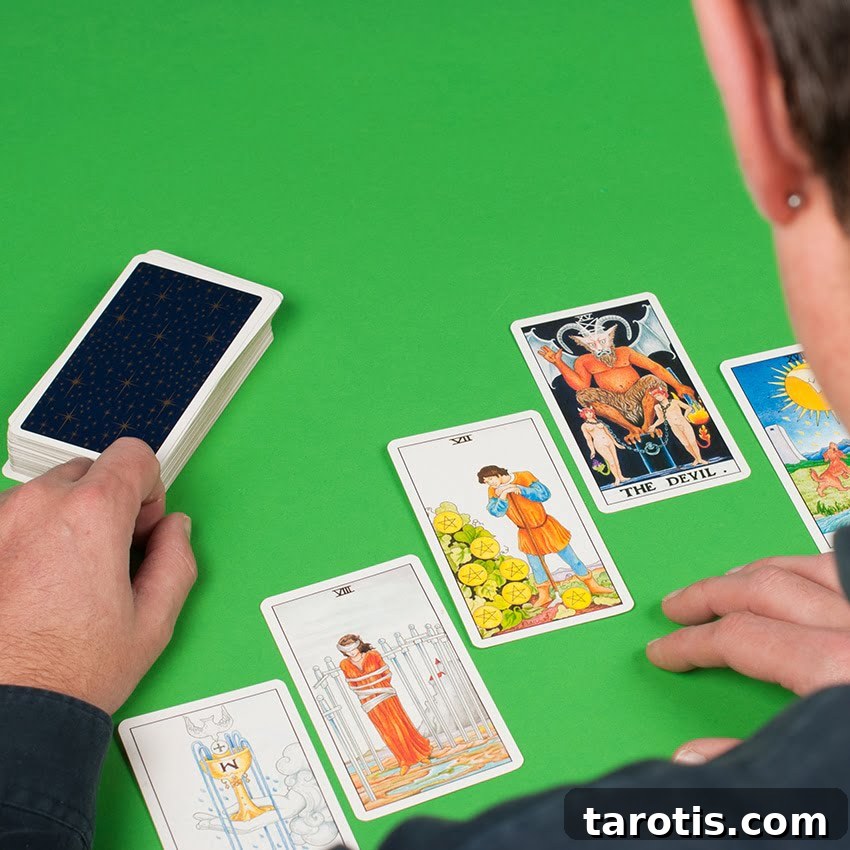
As a method of guidance and a practical tool to help navigate many areas of life, Tarot readings can be very helpful when deciding which direction to take. Tarot spreads often reveal options, obstacles, and opportunities that might otherwise remain unclear.
Opportunities and turning points appear at different moments in our lives, and often we feel uncertain about the next step. Tarot cards are excellent tools for gaining clarity in these moments.
However, sometimes the Tarot spreads you find in books, magazines, or online don’t match the specific situation or question you have. Common layouts such as the Celtic Cross or a Daily Tarot draw are useful, but they may not cover the exact details you need.
That’s when creating your own personal Tarot spreads becomes valuable. Designing a spread tailored to your question produces more focused answers and gives your readings a personal touch, better suited to your style and needs as a reader.
Once you create a spread, you can reuse it whenever that topic arises, and over time you may build a collection of personalized spreads that work best for you.
To get started designing your own spread, consider a few essential steps:
Laying Down the Groundwork
Begin by deciding how much information you want from the reading. This depends on your reading style.
Do you read intuitively and draw a lot of meaning from a single card, or do you prefer multiple cards to form a clear picture?
For example, if you want insight into your romantic life over the next week, you could ask, “What will happen for me romantically during the next week?” You might pull a single card for an overall theme, or seven cards—one for each day—to see daily developments.
Your choice depends on how much detail you prefer and how comfortable you are interpreting multiple cards together.
Pinpointing the Specifics
The main advantage of a custom spread is specificity. When you frame your question, list the exact points you want answered. Writing sub-questions helps you structure the spread and ensures you gather the information you need.
For instance, if you submitted a business proposal and want insight into its progress, you could break the main question into targeted inquiries:
- What does the company think of me? (1 card)
- What does the company think of the business proposal? (1 card)
- How does the company feel about the business proposal? (1 card)
- What are the positives of the business proposal? (1 card)
- What are the negatives of the business proposal? (1 card)
- What action will the company take next? (1 card)
- What action should I take next regarding the proposal? (1 card)
A seven-card spread like this balances detail with manageability, but if you’re new to creating spreads, start smaller—three-card layouts are an excellent practice format.
These sub-questions tell a story and map out the progression of events. Thinking in narrative terms makes it easier to determine which aspects need coverage. Keep a notepad handy to jot down your main question and the finer points you want explored.
Drawing Out Your Spread
Unless you have an exceptional memory, sketching your spread helps you keep track of positions and meanings. For a multi-card layout—like the seven-card example—drawing the pattern in a notebook provides a visual reference while you shuffle and lay out the cards.
Having a drawn layout also helps with concentration during shuffling, blocking out distractions and keeping your focus on the question and its parts.
Time to Get Creative with Your Spread
Personal Tarot spreads let you build a deeper relationship with your deck and tailor readings to specific situations. A custom spread can reveal nuances standard spreads don’t address, and many readers come to prefer their own layouts over generic ones.
As with any Tarot practice, developing your own spreads improves with repetition and intuition. Experiment with different positions and question structures, and share your creations if you like—other readers may find your approach useful too.
Try the methods outlined here and see what unique spreads you can design for your questions and life paths.
Related article: How to Choose a Tarot Deck