
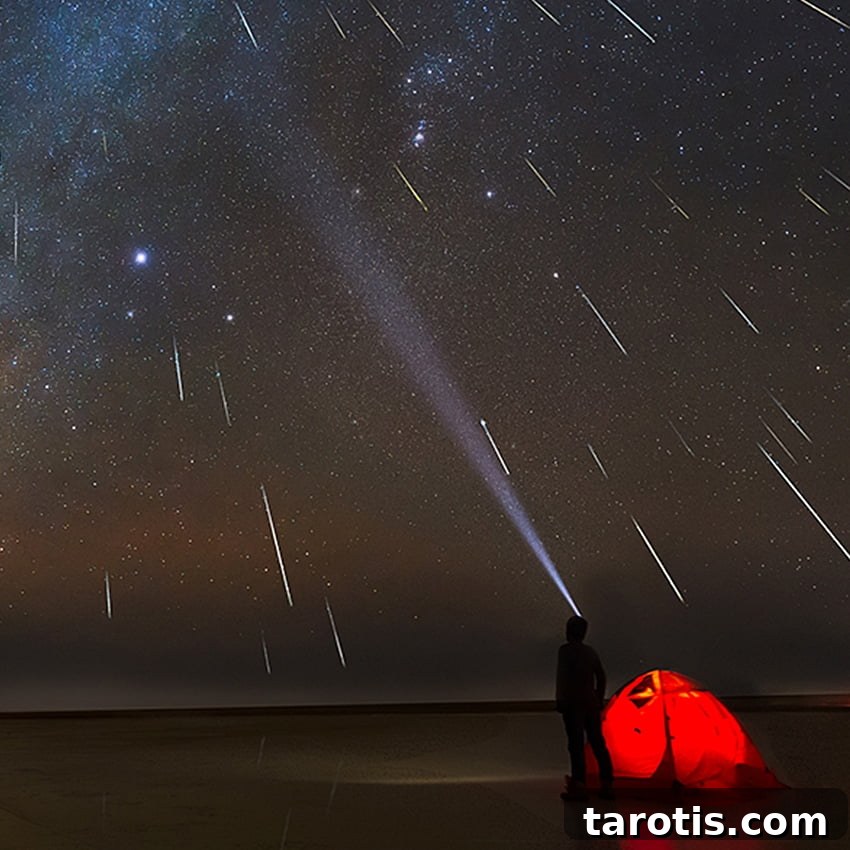
Have you ever watched the brilliance of a meteor shower streaking across the night sky?
Meteors are small fragments of space debris that enter Earth’s atmosphere and ignite, creating the brief, luminous trails we call shooting stars. Beyond their visual appeal, meteor showers also carry symbolic and astrological meaning worth exploring.
Although meteors are far smaller and less influential than planets in traditional astrology, their recurring appearances and the energy they stir in the upper atmosphere can still resonate with us emotionally and spiritually. Ancient astrologers often treated meteoric events as significant, and modern interpreters continue to find symbolic value in them.
In this article we’ll examine meteor showers, their astrological associations, how different showers are interpreted, and how to make the most of these celestial events for intention-setting and manifestation.
What Are Meteor Showers?
Meteors—sometimes called meteoroids when they are in space—are tiny pieces of rock and dust that heat up and glow as they plunge through Earth’s atmosphere. When many meteors appear to radiate from a single area of the sky over several hours, we call that a meteor shower. These showers occur when Earth crosses a stream of debris left behind by comets or asteroids.
The Astrological Significance of Meteor Showers
Astrology traditionally focuses on planets, luminaries, and fixed stars, but events and objects within our solar system can shift the atmosphere’s energy and influence human moods and rituals. Meteor showers are often associated with change, renewal, and transformation—similar in vibe to a New Moon or lunar eclipse.
Because meteor showers arrive as sudden, visible bursts of energy, they invite us to look forward, release what no longer serves us, and imagine new possibilities. They can be powerful moments for manifestation, intention-setting, and dream work, as well as simple reminders to pause and appreciate the mystery of the cosmos.
Why Do We Wish Upon a Star?
The tradition of wishing on a shooting star traces back through folklore and ancient beliefs. Some early thinkers, like the Greco-Roman astronomer Ptolemy, imagined meteors as openings in the veil between the divine and human realms. Others believed shooting stars carried the essence of souls, making them auspicious objects to wish upon.
Folk traditions also assigned omens to the direction and timing of a meteor’s appearance. For example, a meteor seen to the right might be interpreted as a sign of good fortune, while one on the left could be read as a warning. Many cultures held the first meteor observed during a shower as especially potent for wishes.
These beliefs fed simple, enduring customs such as the nursery rhyme:
Starlight, star bright,
First star I see tonight,
I wish I may; I wish I might,
Have this wish I wish tonight.
When you spot a shooting star, it’s still a fitting moment to pause, make a wish, and set an intention.
Recurring Meteor Showers
Recurring meteor showers—those that return each year—are often seen as especially suited to rituals of intention and manifestation, because their repeatability creates a reliable rhythm for seasonal reflection and goal-setting.
Perseids Meteor Shower
The Perseids appear annually from mid-July through late August, peaking in August. These meteors originate from debris left by Comet Swift-Tuttle and can produce dozens to over a hundred visible meteors per hour under ideal conditions. Named for the constellation Perseus, this shower is associated with courage, renewal, and letting go of past fears. It’s an excellent time to focus on emotional healing and to wish for mental and spiritual wellbeing.
Draconid Meteor Shower
The Draconids occur each October and are linked to debris from Comet 21P/Giacobini-Zinner. Though often more modest in meteor counts than the Perseids, the Draconids carry a potent energy of transformation. Named for the constellation Draco, the dragon, this shower connects to themes of inner strength, creative power, and guarded treasures. During Draconid nights, you might concentrate on reclaiming courage, artistic expression, or a resilient, authentic identity.
Do Meteor Showers Affect Your Birth Chart?
Meteor showers do not alter the structural elements of an individual natal birth chart. Because meteors occur in Earth’s upper atmosphere and are transient events, they don’t integrate into the archetypal framework of natal astrology in the same way planets and significant luminaries do.
That said, meteor showers still hold subjective astrological significance. They act as symbolic opportunities for change and fresh starts—moments to harness intention, perform rituals, or simply reflect on hopes and desires.
When Is the Next Meteor Shower?
If you want to plan a night of stargazing and intention-setting, look to annual meteor shower calendars to find upcoming peaks. One of the major showers later in the year is the Geminids, active in early to mid-December with peak activity typically around the 13th and 14th. Geminids often produce bright, plentiful meteors and are ideal for cozy observation and conscious wish-making.
Don’t Forget to Make a Wish
Meteor showers connect us to a larger cosmos and invite reflection, release, and hopeful dreaming. Even if they are not central to formal astrological charts, these luminous events remain meaningful cultural and spiritual touchstones. When you next see a shooting star, take a moment to breathe, focus on what you truly want, and make a wish.
What will you wish for next time you see a shooting star?