
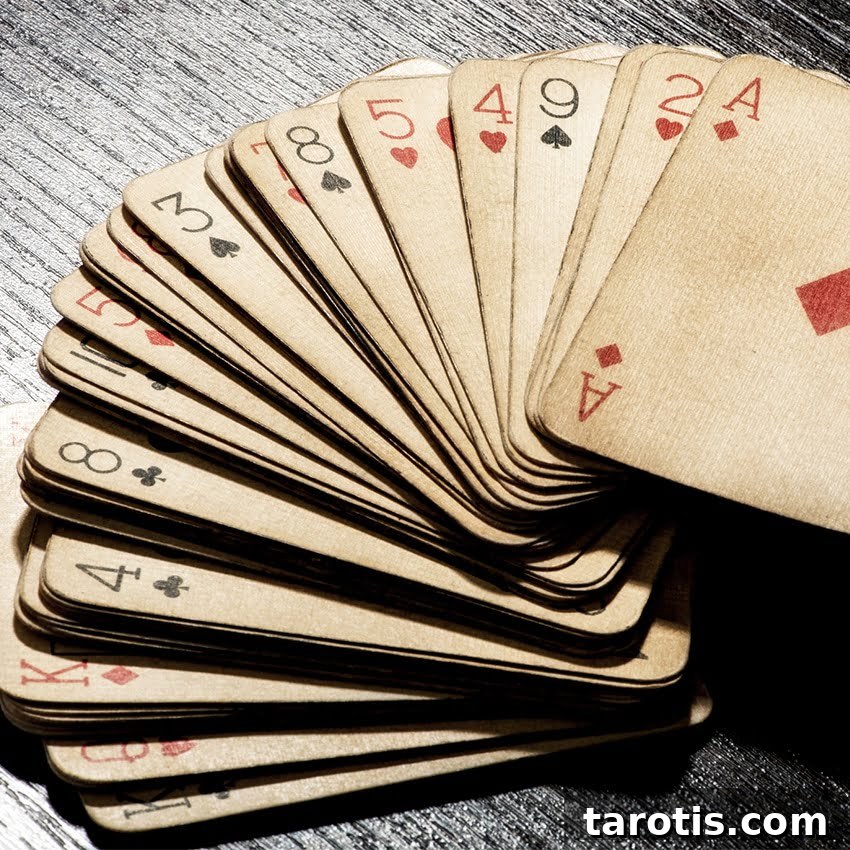
Many people admire those who can read tarot cards, astrology charts, palms, or tea leaves — and with good reason. Skilled readers often spend years studying their tools, developing a strong code of ethics, and gaining experience with real readings. Still, you don’t always need tarot decks, crystals, or elaborate metaphysical tools to glimpse the future. Everyday items, like a standard deck of playing cards, can be used for divination.
Playing card divination has deep roots and strong parallels with the Tarot. Both systems contain four suits of thirteen cards each; the Tarot adds an extra court card per suit and a set of 22 trumps known as the Major Arcana. When used for fortune-telling, playing cards are most often read in a way that corresponds to the Tarot’s Minor Arcana. The technique is easy to learn but rewards lifelong practice.
The Meanings of the Cards
To read playing cards effectively, start by understanding what each suit represents and the seasonal or timing associations often attributed to them:
- The suit of hearts concerns emotions, relationships, and matters of the heart. Hearts are commonly associated with summer.
- Diamonds relate to money, material concerns, possessions, and practical matters. They are often linked to winter.
- Clubs point to friendships, social activity, work that requires action, and energetic pursuits. Clubs are associated with spring.
- Spades signal challenges, warnings, conflict, or turning points, and they tend to resonate with autumn.
Each rank within the suits carries its own symbolic meaning as well:
- Aces: New beginnings, fresh starts.
- Twos: A decision or choice that must be made.
- Threes: Things beginning to fall into place; creative growth.
- Fours: Foundation, stability, structure.
- Fives: Change or a significant event about to occur.
- Sixes: Lack of focus or the need to restore balance.
- Sevens: Luck or chance — can be positive or negative depending on nearby cards.
- Eights: Fate, destiny, or forces beyond immediate control.
- Nines: Tension or decisions reaching a critical point.
- Tens: Completion, fulfillment, or endings.
- Jacks: Messages, news, or incoming information.
- Queens: Intuition, knowledge, sensitivity, and awareness.
- Kings: Authority, confidence, leadership, or ego.
- The Joker: Optional in readings. When used, the joker often represents unpredictability or sudden change, a reminder that outcomes can shift unexpectedly.
Once you recognize the suits and card meanings, combine them to form interpretations. For example, an eight symbolizes fate. If you draw the 8 of Hearts, it might indicate a destined event in a relationship or an emotional turning point. The 8 of Spades, however, could point to an unavoidable conflict or difficult choice that lies ahead. Effective readings come from linking card meanings into a coherent story about the situation you’re exploring.
The Layout of the Cards
When reading playing cards, you place them in a spread or layout on a flat surface. A spread organizes the positions and roles of cards in relation to your question. There are countless layouts; beginner-friendly options include three-card and four-card spreads. A four-card spread is simple, clear, and ideal for those new to playing-card divination.
To perform a basic four-card spread, shuffle your deck while focusing on your question. Lay four cards face down from left to right, then turn them over and read them in order:
- Card #1: The central theme or heart of your question.
- Card #2: Advantages, strengths, or helpful energies working in your favor.
- Card #3: Challenges, obstacles, or factors working against you.
- Card #4: Potential outcome if current conditions continue or if you follow the guidance given.
Notice repeating cards or numbers in a spread. If a rank appears more than once — for example two threes or two queens — those repetitions amplify the message and deserve special attention. Interpreting combinations thoughtfully and objectively will strengthen your readings.
With practice, you will begin to recognize meaningful combinations and patterns, and your ability to translate card imagery into practical insight will grow. Storytelling is a large part of divinatory skill; the cards provide symbolic cues, and you craft the narrative that connects them to real-life circumstances.
Will You Try This Tarot Method?
You don’t have to be born clairvoyant to learn how to read playing cards for guidance. With patience and experience, you’ll develop an intuitive sense for combinations, timing, and themes. Learning the basics allows you to perform helpful readings right away, but mastery requires ongoing practice, reflection, and humility.
There are no absolute rules for reading your own cards. Choose methods that suit your comfort level and avoid getting trapped by the idea of a single “correct” interpretation. Even seasoned readers consult colleagues or seek second opinions. Approach playing-card divination with respect, an open mind, and the willingness to keep learning from each reading.