
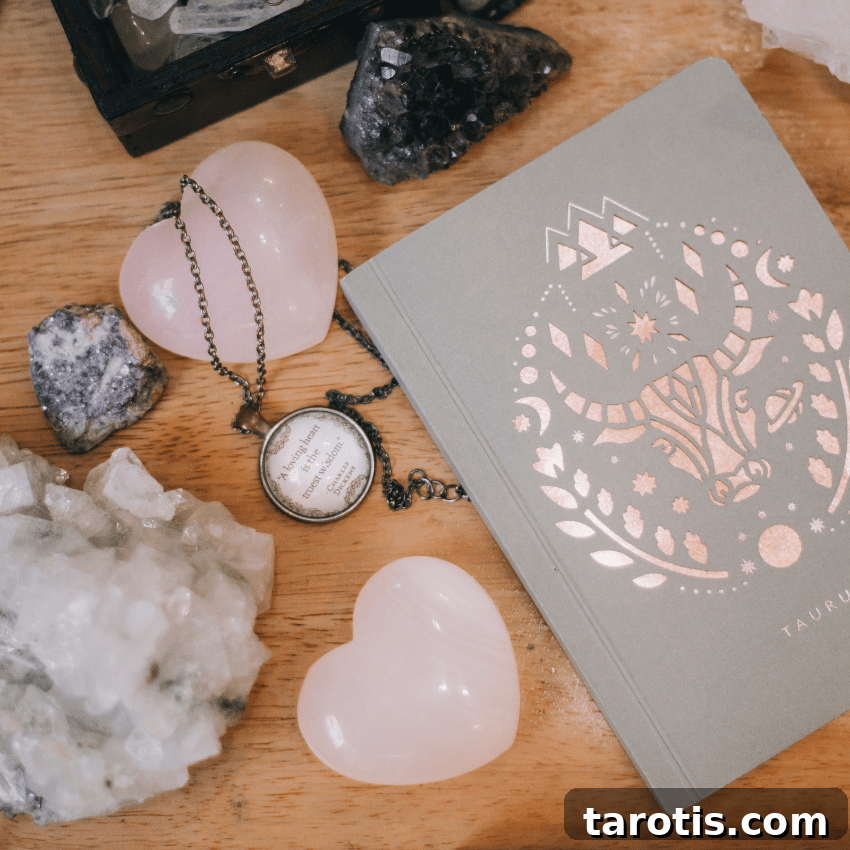
Have you ever wondered what a Tarot journal is and how to keep one?
You’ve come to the right place.
Tarot is growing in popularity as people reconnect with practices once sidelined for generations: Tarot, crystals, numerology, astrology and lunar manifestation. If you find yourself drawn to Tarot, you’re tapping into broader cultural shifts and your own inner guidance.
Let’s look at Tarot journals specifically and how keeping one can deepen your practice.
Tarot Journal for Beginners
Tarot journals are highly personal—no two look exactly alike. Still, a few essentials will help any beginner get started:
- An empty journal and a pen (digital journals work fine if you prefer typing)
- A Tarot deck
- Regular time to practice — even ten minutes a day or an hour a week will make a difference
Create a quiet, comfortable space where you can concentrate. Some people add crystals, candles, or incense to set an atmosphere for readings and writing.
What to Write in a Tarot Journal & Examples
A Tarot journal documents your evolving relationship with the cards: interpretations of readings, personal meanings of cards, and reflections that sharpen your intuition and skill.
Journals can include written entries, sketches, photos of layouts, or collaged images. Keep it plain if you need privacy, or decorate it to reflect your personal aesthetic—either way is valid.
1. Daily Draw
A simple, effective habit is a daily one-card draw. Shuffle, pick a card, and write what it means to you in the moment—just a few lines or a short paragraph. Over time this practice builds intuition and familiarity with the cards.
2. Longer Readings
For multi-card spreads like the Celtic Cross or relationship layouts, record each card and your interpretation. Note your impressions, feelings, and outcomes you observe later. Taking a photo of the spread or sketching the layout helps preserve placement context, which is useful for learning and comparing readings over time.
Longer readings may take an hour or more to interpret and document thoroughly, so set aside extra time when possible.
3. The Major Arcana Journey
Working through the 22 Major Arcana cards as a storytelling exercise can deepen your understanding of archetypal themes. Lay out each Major Arcana card and relate it to a moment or phase in your life. For example, connect The Fool to a new beginning—starting university, a first job, or a fresh relationship—and write about how that experience matches the card’s energy.
This can be an ongoing, reflective project, using multiple life events for each card if you wish.
4. Deck Inventory
Keep a list of the decks you own and note which decks you gravitate toward for different types of readings. Over time you’ll notice preferences and patterns that help you choose the right deck for the question at hand.
5. Assign Court Cards to People You Know
To learn court cards more intuitively, assign them to friends, family or public figures whose personalities match the cards. This association helps you read court cards with greater nuance when they appear in spreads.
Let Your Journal Be Your Guide
Write in your Tarot journal whenever it fits your rhythm. Many practitioners do a brief morning draw to set the day’s tone, while others save deeper work for evening reflection. The key is consistency and honesty with your observations.
A Tarot journal becomes a personal archive of growth—your friend, guide and mirror. Reviewing past entries reveals patterns, validates your insights, and helps you refine interpretations as your practice develops.
Start small, be curious, and let the journal evolve with you. Over time it will become an invaluable tool for learning, reflection and spiritual growth.