
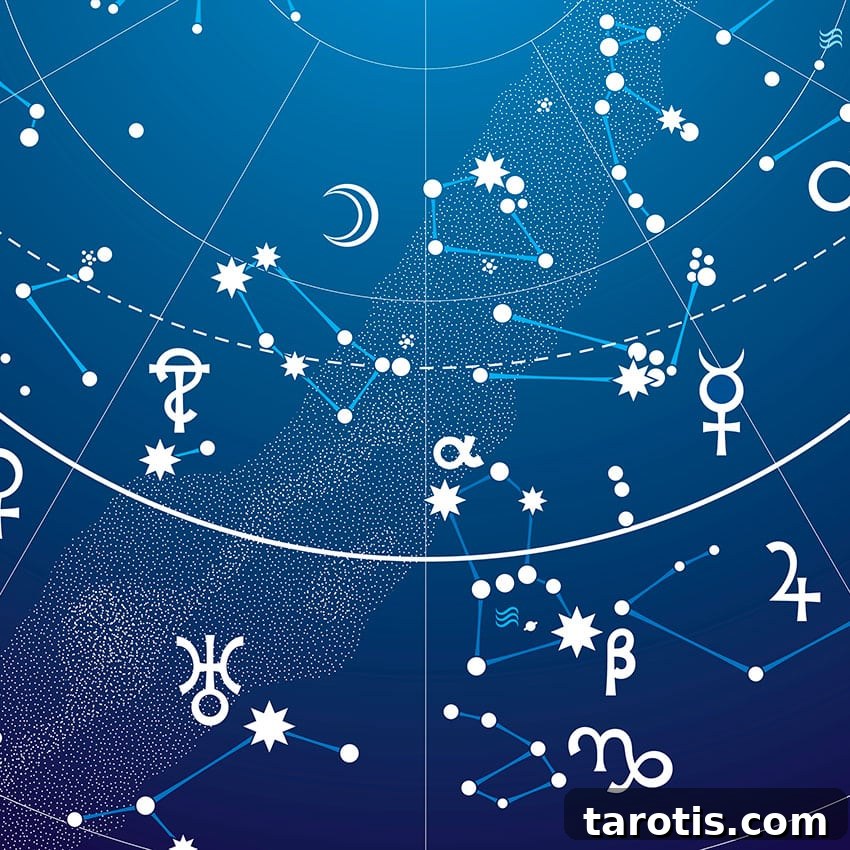
If you want to explore the language of the stars, begin with your birth chart. A birth chart is a time capsule of the sky at the exact moment and place you were born, and it reveals a person’s deepest desires, natural talents, and communication style. Many people never move beyond reading a daily or weekly horoscope, but those who learn to read a birth chart find a practical tool for understanding relationships, strengths, and blind spots.
To generate an accurate birth chart you need your full birth date, the exact time you were born, and the city of birth. With that information, the chart maps the positions of the Sun, Moon, and planets at your moment of arrival—creating a unique blueprint that you can study and apply to your life.
The Symbols
Reading a chart starts with learning the pictorial symbols used for planets and zodiac signs. There are symbols for the Sun, Moon, Mercury, Venus, Mars, Jupiter, Saturn, Uranus, Neptune, and Pluto, plus a symbol for each of the 12 zodiac signs. These icons are the basic alphabet of astrology; once you recognize them the chart begins to make sense instead of looking like a foreign script.
The Planets
Each planet represents a kind of energy or area of life. The Sun reflects core personality and vitality. The Moon governs emotions and instincts. Mercury rules thinking and communication. Venus relates to love, beauty, and values. Mars governs drive and assertiveness. Jupiter connects to growth, luck, and opportunity. Saturn represents structure, discipline, and lessons. Uranus brings innovation and rebellion. Neptune rules imagination, dreams, and the unseen. Pluto oversees transformation and renewal.
Planets placed in different zodiac signs adopt the flavor of those signs. For example, a Sun in Virgo suggests a personality that values organization and service, while Mercury in Leo colors communication with warmth, confidence, and sometimes theatrical flair.
The Zodiac Signs
Each zodiac sign carries a set of central qualities that influence how planetary energies express themselves. Briefly:
- Aries: initiatory, bold, sometimes quick-tempered.
- Taurus: steady, sensual, fond of comfort and quality.
- Gemini: curious, adaptable, communicative.
- Cancer: sensitive, nurturing, home-oriented.
- Leo: expressive, confident, proud.
- Virgo: detail-focused, helpful, practical.
- Libra: balanced, sociable, fairness-minded.
- Scorpio: intense, private, emotionally profound.
- Sagittarius: adventurous, philosophical, freedom-loving.
- Capricorn: disciplined, responsible, goal-driven.
- Aquarius: visionary, community-minded, unconventional.
- Pisces: compassionate, imaginative, artistic.
The Outer Wheel
The outer ring of a natal chart displays the twelve zodiac signs and is where you locate planetary symbols to see which sign each planet occupies. The Sun is shown as a circle with a dot and reveals your Sun sign—the core of who you are. The Moon is represented by a crescent and indicates your emotional nature and inner needs. Your Rising sign, or Ascendant, appears on the left-hand horizon of the chart (often marked AS) and describes the persona you present to the world—how others first perceive you.
Knowing your Sun, Moon, and Rising signs is a foundational step. The Sun shows your essential identity, the Moon reveals private emotional patterns, and the Ascendant tells how you interact with your environment and make your initial impression.
The Inner Wheel
The inner part of the chart is divided into twelve houses. Each house corresponds to a life area and shows where planetary energies are likely to manifest. A basic summary:
- 1st house: self, approach to life, identity.
- 2nd house: personal resources, talents, values, money.
- 3rd house: communication, immediate environment, learning.
- 4th house: home, family, roots.
- 5th house: creativity, romance, self-expression.
- 6th house: daily work, health, service.
- 7th house: partnerships, committed relationships.
- 8th house: transformation, shared resources, endings and beginnings.
- 9th house: beliefs, higher learning, travel.
- 10th house: career, public reputation, achievements.
- 11th house: friendships, groups, hopes and wishes.
- 12th house: spirituality, solitude, inner growth.
To interpret houses, note which zodiac sign sits on the cusp of each house. For instance, if Scorpio rules your 7th house, you may seek intensity and emotional depth in close partnerships or attract partners who are private and transformative.
Putting It Together
After you master symbols, planetary meanings, zodiac signs, and houses, you can begin to work with aspects—the angles planets make to each other—such as conjunctions, sextiles, squares, trines, and oppositions. Aspects refine how planetary energies interact, but it’s best to focus first on the basics before diving into those patterns.
Studying a natal chart is a process of assembling many pieces: the planets describe the themes, signs color how those themes express, and houses show where in life they play out. With practice you can read charts in ways that reveal strengths, challenges, and life themes. A well-interpreted birth chart offers guidance about what comes naturally and what might require conscious effort, helping a person align with their potential and purpose.
Every individual arrives with a unique set of gifts and lessons. The natal chart is a map that helps identify those qualities and offers insight into personal growth. Approached thoughtfully, it can be a helpful tool for self-awareness and a meaningful guide for living a purposeful life.